


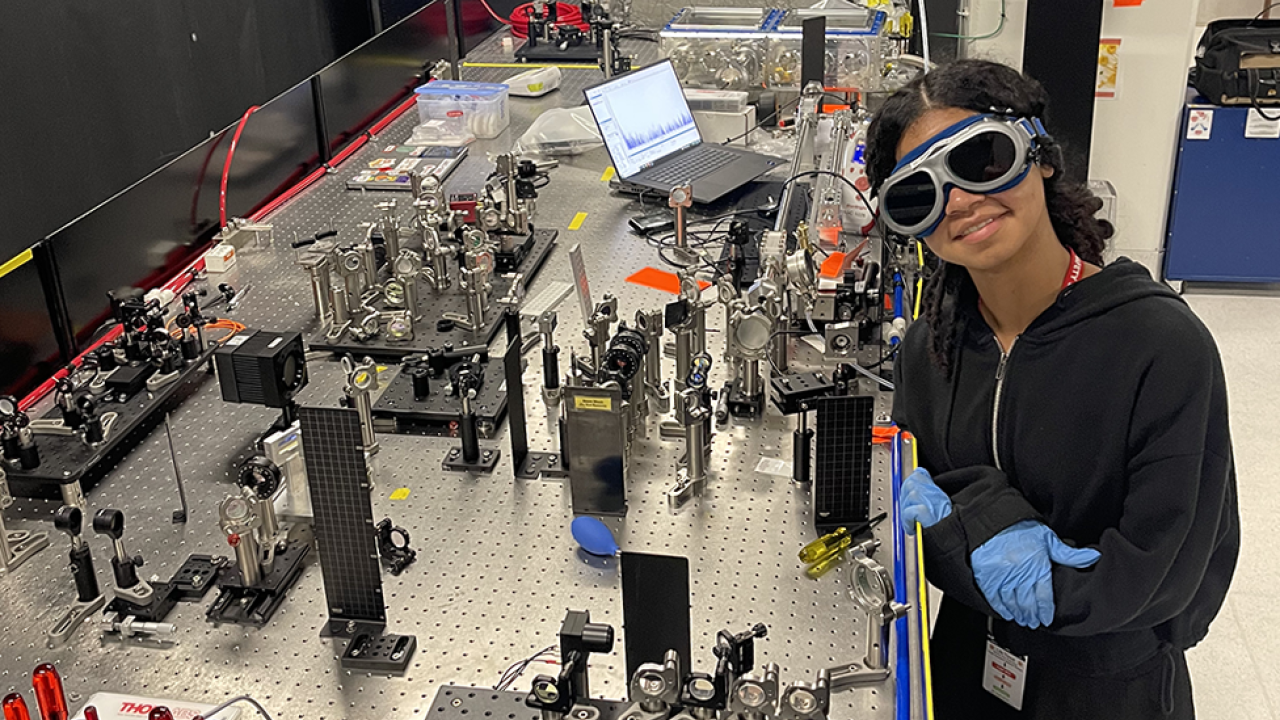


Kelsey Stallard was nervous attending meetings of her first physics internship on campus. It was the summer after her first year at UC Davis. In physics, she had only taken the general introductory course, but she had also ranked first in her class the whole year.
“I feel like there's still always some impostor syndrome,” she said, now a third-year physics major in the College of Letters and Science. “I feel like I'm always just still a bit concerned about not knowing enough.”
Those first meetings had ups and downs. She knew some of the physics the professor discussed. Some of the more advanced physics she didn’t understand at all.
This is normal, she reminded herself. That summer, being confused became the natural way of things. Leaning into that confusion with curiosity helped her to overcome it. Her curiosity would also help a year later in an internship at Stanford University where she got to work with lasers.
“You get confused about something and then you learn it and you overcome it and then you just level up,” she said.
The first steps toward a future in science

Stallard’s first internship at UC Davis was with a nuclear physics lab led by Manuel Calderón de la Barca Sánchez. The opportunity came by happenstance.
Even before arriving at UC Davis, she was part of the Linda Frances Alexander Scholars Program Scholars Program. It was at a LFA event where she met Lolita Adkins, an Undergraduate Research Center manager and administrative director. Months later they met again by chance at the Coffee House.
Adkins remembered Stallard was studying physics and suggested she contact Calderón de la Barca Sánchez about a job in his physics lab. Stallard wrote him a cold email. He responded right away. A week later she was studying the properties and geometry of heavy ion collisions in her first physics internship.
“It's good to be involved, because you never know what kind of doors are going to open,” said Stallard.
Support and mentorship in the transition to college
In Stallard’s first year at UC Davis, she took part in the College of Letters and Science Student Transition and Retention Program, or STaR, which helps bridge the gap from high school to college. STaR offers weekly seminars and mentorship, which Stallard said is important so students don’t feel lost on a university campus this size.
There was one day when academic advisor and STaR instructor Mike Valenzuela mentioned that she looked stressed lately and asked if she was okay. It meant a lot to her that someone on campus knew her well enough to ask.
“Those moments meant a lot to me,” said Stallard. “Being a part of a community like that my first year just like really helped me to feel like I mattered.”
Playing with lasers at Stanford
When Stallard learned about a physics internship at Stanford University, she debated whether or not to apply. It seemed like all around her were other brilliant people who had more experience, who had taken more classes. Maybe if she gave herself more time, she’d have a better shot.
She applied anyway.
“I really didn't want to be my own obstacle,” said Stallard. “If somebody else doesn't want to take me on as an intern or mentor me, then that's their choice to make but I'm not going to say no for them.”
She was surprised she got an interview. Then she got the job, which came with lasers.
During her internship at SLAC National Accelerator Laboratory last summer, Stallard witnessed a nonlinear effect called self-phase modulation (SPM) which occurs in the presence of strong electric fields to generate light of various wavelengths. The light itself shone like a tiny rainbow. The electrical field was so strong that she could hear the air being ionized.
“It was really cool being able to play with lasers,” said Stallard. “I would always tell my mentor I love SPM, like all I want for Christmas is SPM.”
Her project was to develop a method for creating ultrafast, deep ultraviolet laser pulses for experiments involving the electronic properties of atoms and molecules. It was the first time she felt like everything she had learned in her classes at UC Davis was coming together. She found that it was one thing to be exposed to new material in class, and another thing entirely to really learn it by using it in the lab.
Toward the end of the internship, she gave presentations on her research there. She was also selected for the Steve Edstrom internship award for the outstanding intern project in laser science and engineering.
“I was not expecting it, because honestly I just had fun playing with the lasers and driving the project forward,” said Stallard.
A future in physics and mentorship
Stallard has just begun her third internship at UC Davis, this one with Professor John Conway. They haven’t decided yet what her research project will be, so she is starting with the basics of particle physics.

She has also become lead peer mentor for the STaR program. She knows how the first year of college is a pivotal time when students choose or change majors. Some decide whether they will stay at all. It’s critical, she said, to provide support especially at that stage and to help them be successful.
Her experiences in physics labs have also motivated her to continue to work hard in her classes. It’s like a positive feedback loop, where both in-class learning and practical work in the lab build upon each other to create an even more enriching experience.
She also thinks about stretch opportunities, like the internship at Stanford, as a way to stay open to what’s possible.
“I could not try, or I could try and see what happens,” she said. “Don't plan for it per se, but it's kind of fun if you just try and see what happens.”
YOU MAY ALSO LIKE THESE STORIES

A Semester in Madrid: Kate Villegas' Study Abroad Journey
Types of study abroad experiences are endless. Students can even take GE courses abroad while immersing themselves in a new culture, and that is an option Kate pursued. As a fifth-year double-major in human development and communications, Kate Villegas took part in a study abroad program in Madrid, Spain.
How Curiosity, Openness and Learning Led to Confidence for One Graduating Senior
Lidia Wolday didn’t see herself as someone who could do research when she arrived at UC Davis. A first-generation student, she had just transferred from a community college. This year she graduates with new confidence from her experiences conducting and presenting her own academic research.