lettersandsciencemag
UC Davis Logo
UC Davis Logo
Site Logo
lettersandsciencemag
Main navigation (extended config)
  • ARTS & HUMANITIES
  • SCIENCE & TECHNOLOGY
  • SELF & SOCIETY
  • NEWS & NOTEWORTHY
  • BOOKSHELF
  • COMMUNITY
  • EVENTS

SCIENCE & TECHNOLOGY

Scattered broken seashells and fragments on a sandy, pebbly beach

MARINE SCIENCE

How Crushed Shells Protect Against Ocean Acidification

Abstract teal particle vortex graphic with glowing spheres on dark background

CHEMISTRY

Spinning Electrons in High Magnetic Fields

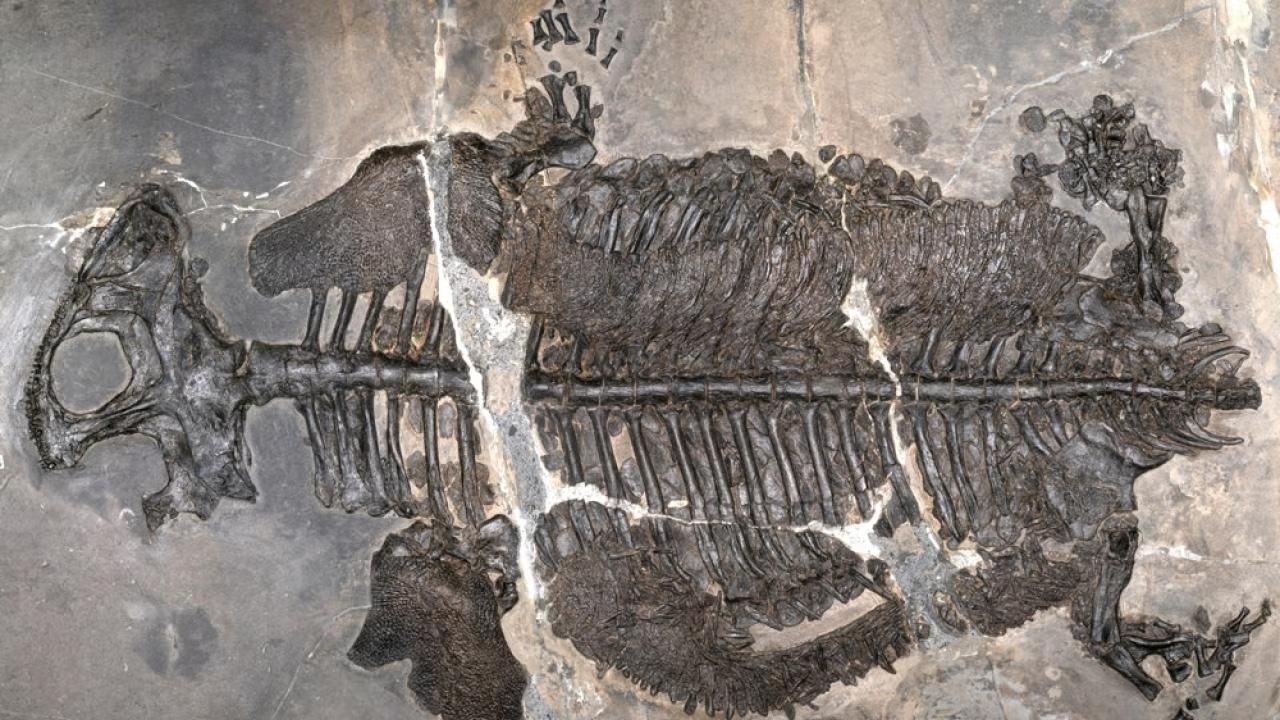
Fossilized turtle skeleton preserved in gray rock slab (photograph)

Researchers Unearth Fossil Evidence of First Fully Marine Amphibian

by Greg Watry

Ryosuke Motani and colleagues show that unlike modern amphibians, the 237-million-year-old giant salamander-sized amphibian tolerated salt water.


Aerial view of large waves crashing into seaside homes, flooding streets and spraying water.

CLIMATE CHANGE

Securing California’s Flood-Resilient Future

A record-breaking El Niño winter and the potential loss or weakening of federal disaster management services are among the factors that could determine whether Californians face catastrophic floods.

Green kayak bow on calm sea heading toward tree-covered rocky shore at sun rise

ECOMORPHOLOGY

Paddling with Writers and Scientists: 50 Miles, 7 Islands

For six days, Kat Kerlin joined a class of 11 creative writers and scientists from the University of California, Davis, and two outstanding guides as they sea kayaked across the San Juan Islands, off the coast of Washington.

Illustration showing a ribosome and RNA strand floating elegantly against a clean background, symbolizing advanced scientific discovery.

CHEMISTRY

The Cookbook of Health and Disease

How UC Davis RNA editing research is helping develop next-generation therapeutics

Vector graphic: rainbow fan with molecular icons and central colorful molecule on black disc

MEDICINE

Deconstructing LSD for Therapeutic Discoveries

Researchers whittled away at LSD’s core multi-ring structure and synthesized new, simplified versions of it to probe its therapeutic functionality.

Stories you may have missed

Older woman in sunglasses, plaid dress, standing in sunlit grassy field with hay bales

How Enhanced Rock Weathering Can Speed Up Carbon Capture

  • by Greg Watry
  • November 16, 2026
  • Science & Technology
Isabel Montañez and Toby O’Geen are leading a multi-year, comprehensive study to quantify the benefits of applying pulverized basalt rocks to agricultural fields. This not only has the potential to benefit decarbonization efforts, but it could also improve the nutrient content of the soil, a boon for healthier crop production.
Rough, boulder-strewn asteroid floating against black space

Some Asteroids and Meteorites Formed Less Than 2 Million Years After Solar System’s Birth

  • by Greg Watry
  • September 16, 2026
  • Science & Technology
In a new study, a research team used advanced geochemical dating and analysis techniques to reveal that some asteroids and meteorites, such as Ryugu and Ivuna, originate from celestial bodies that formed less than 2 million years after the beginning of the solar system. This coincides with a period when the solar system was forming its first generation of planetesimals, the building blocks of planets. 
Black-and-white photograph of people on a hill watching smoke billow over a burning city

California Earthquakes and What the Next ‘Big One’ Could Look Like

  • by Greg Watry
  • August 21, 2026
  • Science & Technology
At the August Davis Science Café, Michael Oskin led a conversation titled “Earthquakes in California: What Might the Next ‘Big One’ Be Like?” Through field observations, high-resolution topography and various geochronological techniques, Oskin is studying the relatively recent geological record to better understand the tectonic processes and crustal deformations surrounding earthquakes.
Digital illustration of a glowing black hole with warped light and bright accretion disk

Researchers Discover New Equations for Smoothing Out Singularities in Maps

  • by Greg Watry
  • August 19, 2026
  • Science & Technology
We rely on maps to make sense of the world around us. But for most maps, points of extreme irregularity pop up. Those points are called singularities. A new study reports the discovery of a set of equations capable of untangling the distortions in maps caused by singularities.
Older man with white hair and glasses, arms crossed, against star-filled galaxy backdrop

Capturing the Cosmos

  • by Greg Watry
  • August 17, 2026
  • Science & Technology
  • News & Noteworthy
The Vera C. Rubin Observatory recently launched its 10-year astronomical survey to create the most comprehensive, cinematic record of the universe. While thousands of people played a part in making the facility a reality, Tony Tyson played a formative role, acting initially as the facility’s founding director and now its chief scientist. We sat down with Tyson to discuss his background and the technology behind the Rubin Observatory’s revolutionary camera.

Pagination

  • Page 1
  • Next page Next

Story Archive

The College of Letters and Science | Archive | About the Magazine

Subscribe

UC Davis footer logo

University of California, Davis, One Shields Avenue, Davis, CA 95616 | 530-752-1011

  • Questions or comments?
  • Privacy & Accessibility
  • Principles of Community
  • University of California
  • Sitemap
  • Last update: November 13, 2026

Copyright © The Regents of the University of California, Davis campus. All rights reserved.

This site is officially grown in SiteFarm.