


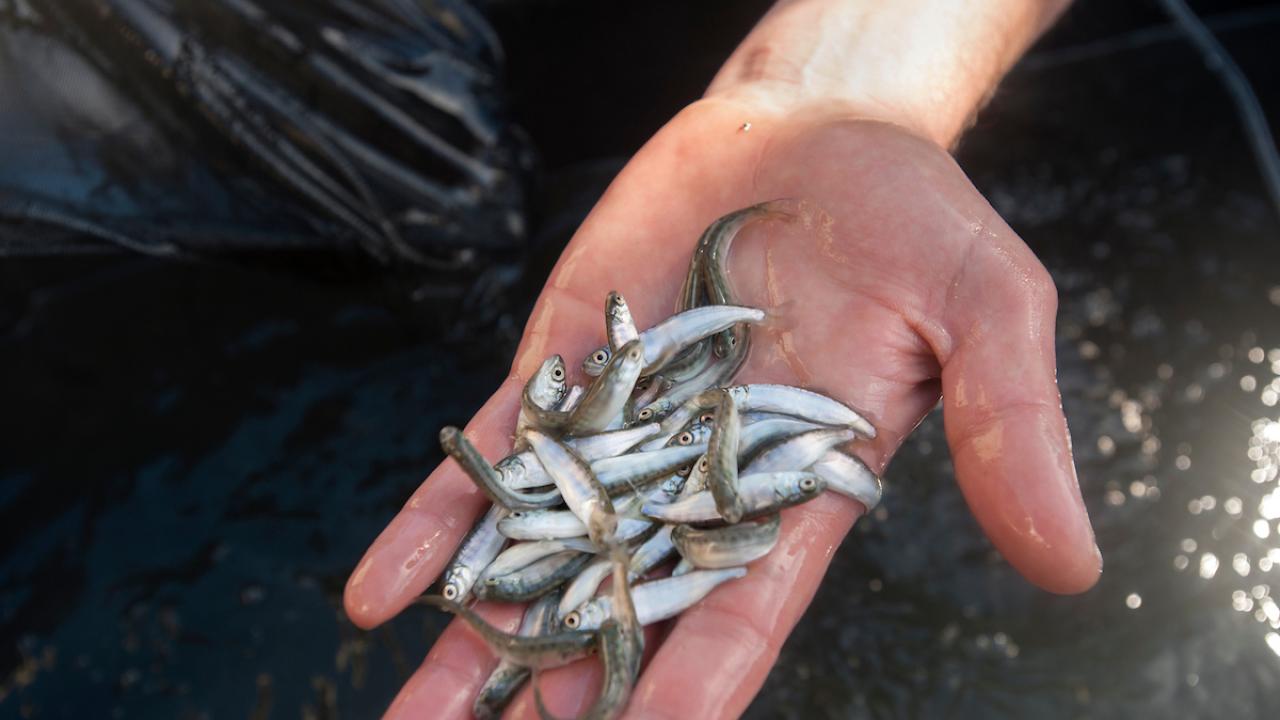


When Carson Jeffres looks at the Yolo Bypass, he sees much more than a heavily trafficked strip of I-80 cutting across land meant for water overflow and agriculture. He sees an ecosystem amidst transformation, one integral to making California, as Jeffres calls it, a “salmon society.”
“The Yolo Bypass is right in our backyard, and it is one of the most amazing, I would say, ecological accidents out there,” said Jeffres, a fish ecologist and field and lab director for the UC Davis Center for Watershed Sciences. “When the Sacramento River flows get high enough that they need to divert them around Sacramento and through the Fremont Weir…that water is then routed through the Yolo Bypass all the way down and it drains on the bottom by the Rio Vista.”
How Chinook salmon grow faster in floodplain habitat
Jeffres and his colleagues have learned that Chinook salmon detouring through the Yolo Bypass grow about eight times faster than those that migrate strictly through the Sacramento River. That’s because the Yolo Bypass is where the food is.
“When the water slows down, it settles out, it grows some algae, and the bugs go crazy,” Jeffres said. “There’s roughly 100 times the invertebrates on the Yolo Bypass, which is fish food, than there are in the river. It’s pretty wild.”
“But one of the challenges,” he added, “is that we had to wait for that flood to get so high that it was endangering Sacramento to divert the water.”
That recently changed. Through the Big Notch Project, the California Department of Water Resources installed “three seasonally operated gates at the Fremont Weir, making it easier for juvenile salmon and sturgeon to move into the Yolo Bypass.”
“This is really us as a people making these investments as a society for our resources,” Jeffres said. If “we want to have abundance again, it can’t be at a small scale. It has to be at a scale that’s meaningful to the species that are traveling from the headwaters up in the rivers all the way up to the ocean and back again.”
Jeffres shared this vision of California as a salmon society with a packed house at G Street WunderBar for the May edition of the Davis Science Café, an event hosted by the Department of Chemistry at the College of Letters and Science.

Instilling connection that leads to recovery
Jeffres has spent much of his lifetime chasing fish, both for fun and for work. His conversation with the public orbited around a single question, “Can we ever actually have recovery without connection?”
Jeffres recalled angling in the early 2000s and how it seemed almost impossible to not catch salmon.
“I would go out looking for steelhead…but there were so many salmon that it would be hard to get a line through without hooking a salmon,” he said. “They were so abundant that I could not even fish for the fish that I wanted to catch.”
But by that time, salmon populations were already in decline. According to The Nature Conservancy, an estimated 5.5 million salmon used to return to California rivers.
“The Central Valley of California had one of the most abundant Chinook salmon populations in the world, not just California but in the world,” Jeffres said. “We had so many salmon in the Central Valley that up until about 1914, we shipped them around the world.”
A confluence of factors, including mining, logging, overharvesting and landscape modifications changed that, Jeffres said.
Since the 1950s, less than 500,000 fish are counted each year, according to The Nature Conservancy.
“When we lose our abundance, we lose our connection and resource, and we lose our cultural identity,” Jeffres said. “We do not identify as a salmon people.”
What Carson Jeffres means by a “salmon society”
When pondering humanity’s connection to salmon, Jeffres often thinks his work with Caleen Sisk, chief and spiritual leader of the Winnemem Wintu Tribe, and the deep connection she and the tribe feel with the fish.
“She has told me over and over again that salmon are a part of her family,” Jeffres said. “For her, it’s actually a spiritual connection that has been there forever.”
“They think of themselves as stewards of the salmon…The Indigenous voices and communities that are here are the original salmon society” he added. “This was really an eye-opening experience…That voice in our Western science space is so valuable.”
Through both his research and outreach efforts, Jeffres is trying to instill that ethos in those around him.
How Putah Creek became a thriving salmon habitat again
Already, progress is being made. A recent example is the transformation of the local Putah Creek into a thriving salmon habitat. Over the past couple of decades, restoration efforts in the area have been funded by a $20 million grant. In fall 2025, a record-breaking 2,100 Chinook salmon spawned in the habitat.
As Jeffres and his colleagues go about their restoration efforts, they’re curious just how many of the salmon spawning in Putah Creek are returning to the place where they hatched. Historically, many of the salmon that spawn in Putah Creek were born in hatcheries.
Through chemical analyses of ear bones from Chinook salmon carcasses recovered in Putah Creek between 2016 and 2021, Jeffres and colleagues found that 11 of the 407 sampledsalmon were born in Putah Creek. The ear bones, or otoliths, capture the water chemistry of their habitats in their calcium carbonate matrix, allowing researchers to pinpoint their places of birth. While 11 salmon may not seem like a lot, it’s more than zero. Restoration is an incremental process.
“This is Putah Creek starting to reawaken again,” Jeffres said.

Why educating young people matters for salmon recovery
Also integral to making California a salmon society is educating the next generation on the importance of these fish.
“When I first met Chief Sisk, she always talked about how they teach the next generation through story, and that those kids are brought up with salmon as their identity and part of their culture,” Jeffres said.
Jeffres frequently collaborates with the UC Davis Center for Community and Citizen Science to bring salmon science to local classrooms in the region. One day, during a fish release, one of the students asked Jeffres why he volunteers with local students and schools.
“I had to think about it for a second and I came back to him, and I was like, ‘Listen, man, you are voting next year and I need you on my team, because if it’s just us — if it’s just a bunch of fish biologists, some resource managers and some [non-governmental organizations], we’re not going to get there,’” he said. “It’s really a societal thing.”
And word of mouth is powerful.
“When you actually start from the youth side of things,” Jeffres added, “you have the opportunity to bring them along, but you also bring their families and communities.”
YOU MAY ALSO LIKE THESE STORIES

Are Humans Earth’s Greatest Evolutionary Force?
At the April Davis Science Café, environmental toxicologist Andrew Whitehead explored not only how our actions as a species affect ourselves, but also how they impact the innumerable species we share the Earth with.

Sneaking Past the Bouncers: How Toxicants Distract Our Body’s Protective Proteins
At the March 2026 Davis Science Café, protein biochemist Sascha Nicklisch discussed how some toxicants, like DDT, sneak past the body's molecular bouncers. Nicklisch's functional research is elucidating exactly how these harmful chemicals bypass our cell’s defense system.