




During the height of the COVID-19 pandemic, Kayleigh Perkov was commissioned to write an exhibition catalog essay about the Crochet Coral Reef, a sprawling piece of art by Australian-born twin sisters Christine and Margaret Wertheim.
“It's a massive project that encourages people to crochet their own pieces of coral in response to growing awareness of the bleaching of the Great Barrier Reef,” said Perkov, an assistant professor of science and technology studies at the College of Letters and Science at UC Davis.
Described as a “one-stitch-at-time meditation on the Anthropocene,” the Crochet Coral Reef takes the biological geometries of its namesake marine invertebrate and manifests them through fabric. The artwork is an example of data physicalization: the act of transforming a dataset into a physical form that people can see, experience and, sometimes, touch.
While Perkov wrote her essay, she began noticing data physicalization popping up more and more in the world around her.
“Once I started to see it, I couldn’t help but see it everywhere,” she said. “I felt like I couldn’t go a week or two without hearing about someone knitting a temperature blanket or temperature scarf.”
What is data physicalization?
Questions about data physicalization percolated in Perkov’s mind. Why would artists use their time and energy to bring physical life to something that already existed in numerical form? And what does that engagement reveal about how society understands knowledge and its pursuit?
“So many projects described themselves as raising awareness, and I think that lens does the projects a disservice,” she said. “Instead, I think these projects collectively struggle with the question of what it means to know something today.”
“We are all so immersed in information and data, but being exposed to data and deeply understanding and grappling with it are different things altogether,” she added. “So many people, professionals and amateur artists alike, turn to data physicalization because it gives them an opportunity to sit with a data set and consider deeply how it was built and what it implies.”
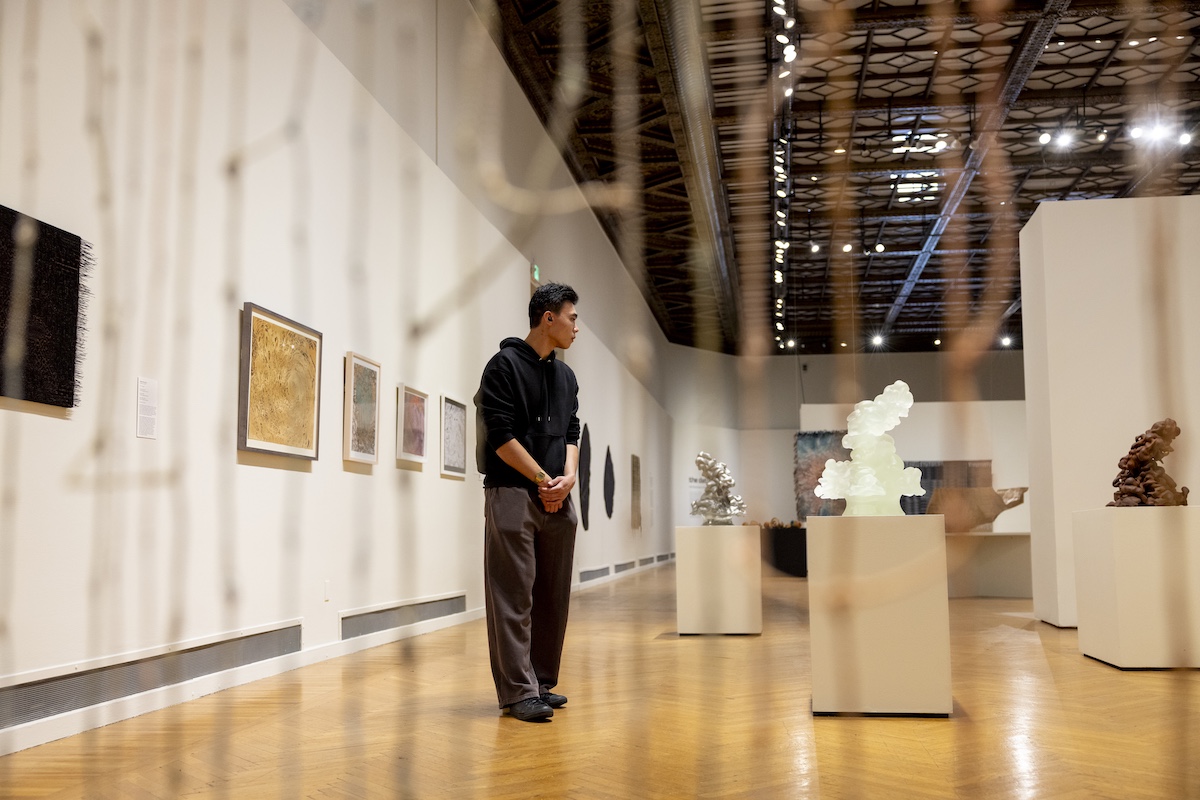
These questions and more are pondered in “The Data at Hand: Data Physicalizations of Earth and Space,” a new art exhibit at the Mills College Art Museum in Oakland. The exhibition was curated by Perkov and will be on display until Dec. 6. Perkov will lead a tour through the exhibit on Dec. 5 at 2 p.m. which will be followed by a signing of the accompanying exhibition publication.
“These artists are really grappling with questions of scientific knowledge in a personal way, trying to understand knowledge not by just passively absorbing it but by actively making something,” Perkov said.
Who gets to decide what counts as scientific knowledge?
Central to “The Data at Hand” exhibit are the questions: What counts as consensus knowledge and who gets to decide?
Collecting data is a practice of categorization, one that is shaped by the human mind. This idea is something that science and technology scholars such as Perkov often wrestle with.
“This work of categorization is always in some part embedded in power relationships,” Perkov said.
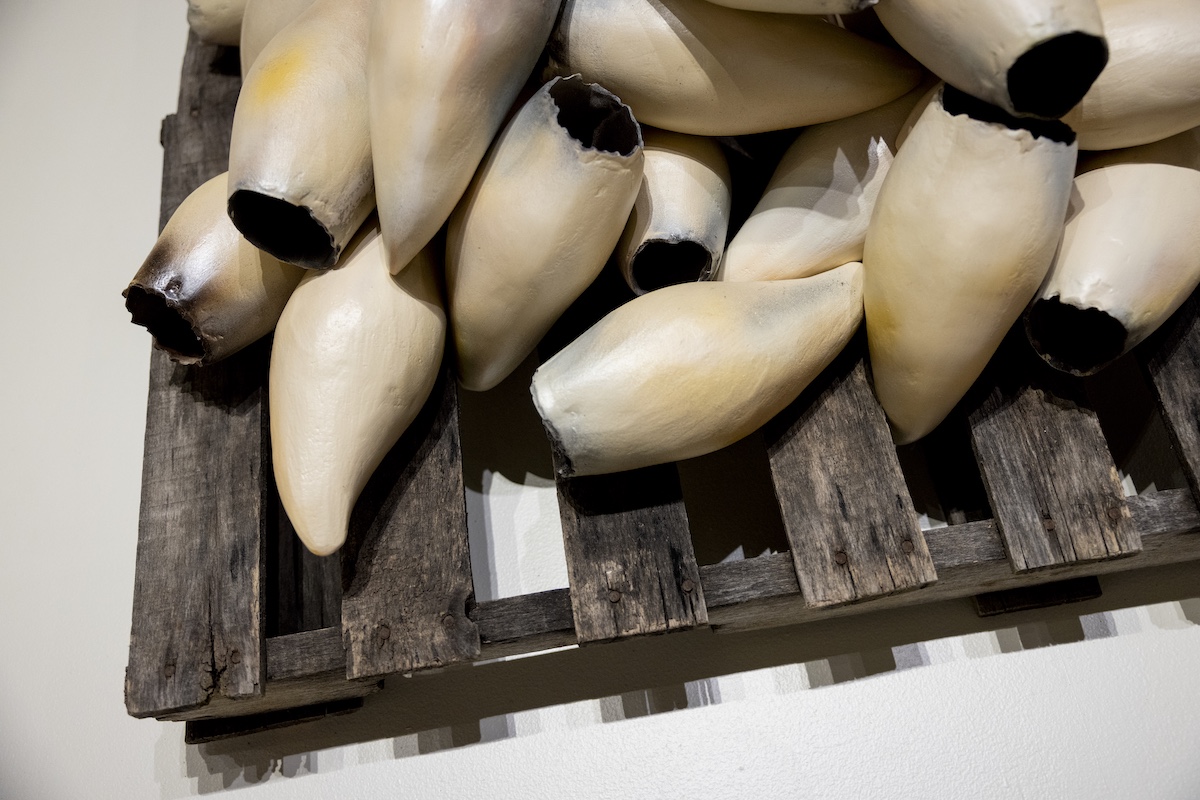
Take the sculpture Breach #2 by Courtney M. Leonard, for instance. The piece consists of a weathered wooden pallet topped with a pile of faux sperm whale teeth fashioned from porcelain. The wooden pallet symbolizes the global shipping industry and its responsibility for many whale deaths worldwide each year.
Leonard is a member of the Shinnecock Indian Nation, which has spiritual and cultural ties to sperm whales.
“She's dealing with how her Shinnecock community is denied access to sperm whale bodies and materials because of the many laws that were created to protect endangered species,” Perkov said. “One effect of this is that Shinnecock people are denied access to an incredibly important cultural resource.”
Another work that comments on power dynamics in science is a hand-stitched cotton diptych by Anna Von Mertens. The work depicts the whirling star trails that appeared in the night sky on the day astronomer Henrietta Leavitt was born and the day she died. A member of the Harvard Computers, a group of women who processed astronomical data at the Harvard College Observatory, Leavitt conducted the foundational analysis of Cepheid variable stars that eventually enabled astronomers to reliably and accurately measure vast cosmic distances.
“Anna draws a direct line between the attention she gives her subjects and the attention the Harvard Computers gave their astronomical glass plates," Perkov said. "She talks about how their knowledge was seen as ‘less than’ at the time because it was focused on details rather than the big picture. But this form of attention is really essential for scientific knowledge to develop, and she argues that her own artistic practice is built on that same kind of attention: long, close, careful observation.”
How does art help us understand science?
For Perkov, art and science are inherently connected. Both require time and dedication; both require long hours of crafting and analyzing; and both are intrinsically human.
With “The Data at Hand” exhibit, Perkov is showcasing how art can help amplify scientific research and be a conduit for greater understanding about the scientific process.
“Having people who are interested in these broader questions but come at them from different angles, I think, is incredibly valuable,” she said. “It helps us see points of commonality.”
YOU MAY ALSO LIKE THESE STORIES

The Cookbook of Health and Disease
UC Davis researchers are advancing RNA editing, a promising approach that could enable new therapies for genetic diseases without permanently altering DNA. The foundational science has shown great promise with the National Institutes of Health has invested millions of dollars in the research.

UC Davis Professor Davide Donadio Scales Two of Tajikistan’s Highest Peaks
What does it take to climb more than 23,000 feet? UC Davis chemistry professor and mountaineer Davide Donadio spent a month in Tajikistan, summiting Ismoil Somoni Peak and Korzhenevskaya Peak in the Pamir