Astronomers using the James Webb Space Telescope have made a surprising discovery about a galaxy long, long ago and far, far away: It isn’t rotating. That’s something only seen in the most massive, mature galaxies that are closer to us in space and time, said Ben Forrest, a research scientist in the Department of Physics and Astronomy at the University of California, Davis, and first author on the paper published May 4 in Nature Astronomy.
At the February 2026 Astronomy on Tap event at Sudwerk Brewing Co., Andrew Wetzel used supercomputer simulations to take the audience through the 13.8-billion-year history of the Milky Way galaxy.
How might falling into a black hole feel? Assuming you’re not ripped apart, a process called spaghettification, and your consciousness remains intact, UC Davis Assistant Professor of Physics and Astronomy Brenna Mockler has some ideas.
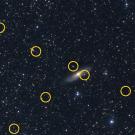
In a study published in The Astrophysical Journal, researchers reveal a markedly different ecosystem from the smaller number of satellite galaxies that circle our Milky Way in the nearby Andromeda galaxy.
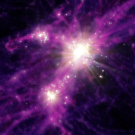
When researchers glimpsed the first images and data from the James Webb Space Telescope, humanity’s largest and most powerful space telescope, they noticed something peculiar. A large number of bright galaxies deep in the universe formed during a period called “Cosmic Dawn." New research published in The Astrophysical Journal Letters shows that a theoretical model produced roughly five years ago predicted these very observations and credits them to bursty star formation.