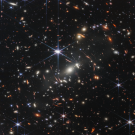
In the past, identifying gravitational lenses in the night sky was an incredibly cumbersome task. It required sharp eyes, time and the drive to sift through tens of thousands of images gathered by telescopes. But within the last five years, researchers like Tucker Jones, through collaboration with computer scientists, have started employing machine learning algorithms to identify gravitational lens candidates in the sky.
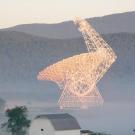
Using a global network of telescopes, astronomers have detected the lowest-mass dark object yet found in the universe. The work is described in two papers published Oct. 9 in Nature Astronomy and Monthly Notices of the Royal Astronomical Society.
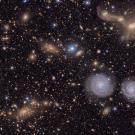
The results of two decades of scientific and technological innovation were unveiled today with the reveal of the first imagery captured by the Vera C. Rubin Observatory, a facility jointly funded by the National Science Foundation and the U.S. Department of Energy's Office of Science.
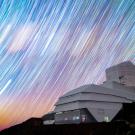
Tony Tyson, a Distinguished Research Professor in the Department of Physics and Astronomy, recounts the origin of the Rubin Observatory and his decades-long journey to make the facility a reality.
At the College of Letters and Science at UC Davis, researchers are using the power of machine learning to help protect us from the next pandemic, discover and build new materials, and explore the myriad galaxies in the heavens above.