


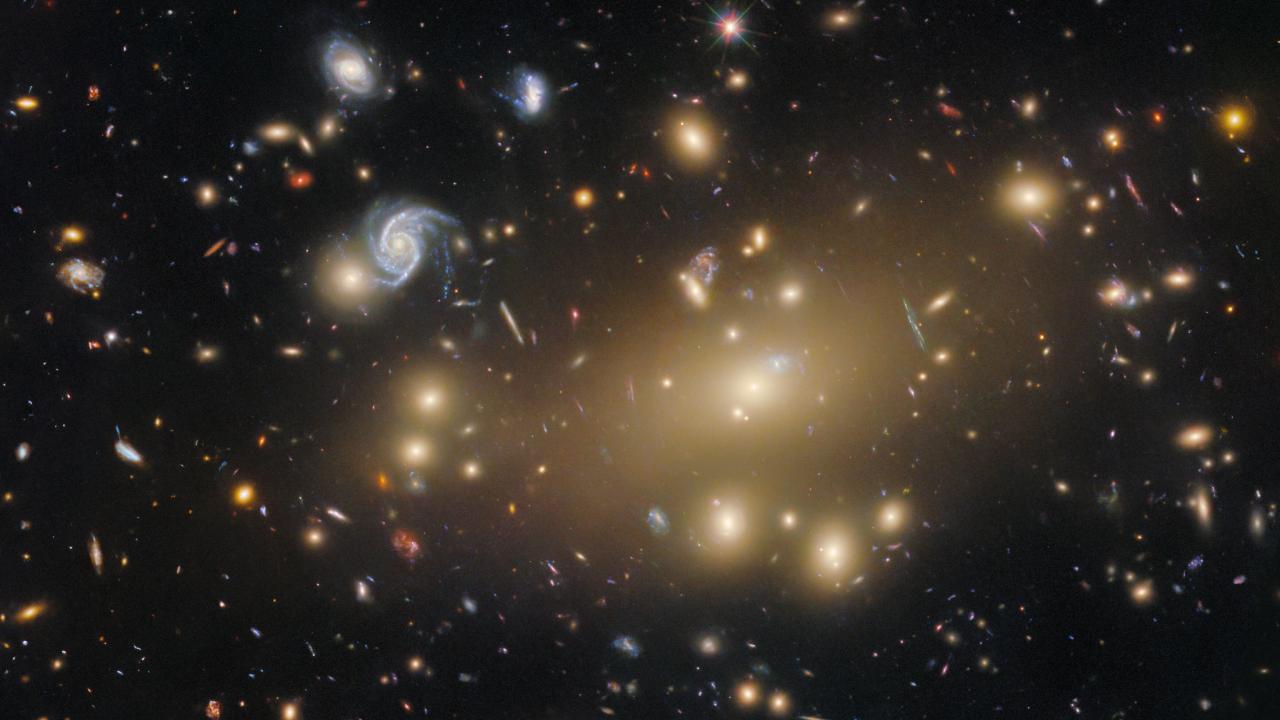


The mysteries behind the expansion of the universe will be explored this November inside the UC Davis Conference Center.
On Tuesday, Nov. 4, Nobel Prize-winning astrophysicist Adam Riess will give a free public lecture titled “The Surprising Expansion History of the Universe.” The lecture will start at 7 p.m. with a reception before the lecture at 6 p.m. The event is being hosted by the College of Letters and Science and the Department of Physics and Astronomy.

Riess — a Bloomberg Distinguished Professor and the Thomas J. Barber Professor of Physics and Astronomy at Johns Hopkins University, and a senior staff member at the Space Telescope Science Institute — will discuss his team’s research on the expansion of the universe, which led to them being awarded the 2011 Nobel Prize in Physics.
“The idea that space can expand itself is amazing,” said Professor of Physics and Astronomy Lloyd Knox, who is also the Michael and Ester Vaida Endowed Chair in Cosmology and Astrophysics at UC Davis. “In every megaparsec of space, there’s about 70 new kilometers being created every second, which is pretty wild trying to get your head around that idea. And that expansion rate has changed dramatically over the billions of years of cosmic history.”
The mystery behind the universe’s expansion rate
For most of the universe’s history (roughly 13.8 billion years), the expansion rate has slowed. But within the last few billion years, that trend has reversed. Riess’ Nobel Prize directly ties to the “discovery of the accelerating expansion of the universe through observations of distant supernovae.”

“Our kind of placeholder explanation for it is that there’s a substance that we call ‘dark energy’ that’s filling the universe, which helps us understand that acceleration mathematically,” said Knox.
Physically though, dark energy is still a mystery. A variety of research efforts seek to quantify and explain it, including research at the Vera C. Rubin Observatory. UC Davis Distinguished Research Professor Tony Tyson, Department of Physics and Astronomy, is a chief scientist at the facility, which is jointly funded by the National Science Foundation and the Department of Energy.
More recently, Riess’ work has led to yet another surprising discovery: the universe’s current rate of expansion differs from the rate predicted by the standard cosmological model.
“That’s been a matter of enormous interest in our community, not because we really care about how fast the universe is expanding today but because we have model-dependent ways of predicting it,” said Knox. “Trying to understand why there is a discrepancy has absorbed a lot of attention in the community and a lot of my research attention. It’s quite possibly a really valuable clue pointing us to a missing ingredient in our understanding of the cosmos.”
Join the free public lecture at UC Davis
Riess’ free public lecture will recount his team’s discoveries, explore how the universe’s expansion has changed over time and dive into why his team’s findings are surprising.
“I’m always happy to get to talk with Adam and I’m delighted that he’ll be coming here,” Knox said. “Our field is a very lively and exciting one, and it’s great to showcase that with an event on campus.”
Knox also hopes the event will showcase the enormous value of research partnerships between the federal government and universities, emphasizing the necessity of collaboration to shepherd new discoveries.
“It’s really important to have that celebrated for our own morale internally but also for the broader community,” he said.
“The Surprising Expansion History of the Universe” free public lecture is scheduled for Tuesday, Nov. 4 at 7 p.m. at the UC Davis Conference Center. Registration is required for attendance. Register for the event here.
YOU MAY ALSO LIKE THESE STORIES

Polarization Signals from Universe’s First Light Emphasize Hubble Tension
UC Davis researchers and their colleagues in the South Pole Telescope (SPT) collaboration used observational data to explore the theoretical underpinnings of the Lambda-cold dark matter model, the standard cosmological model of the Big Bang.
Sifting Through the Cosmic Noise
Tony Tyson, a Distinguished Research Professor in the Department of Physics and Astronomy, recounts the origin of the Rubin Observatory and his decades-long journey to make the facility a reality.