


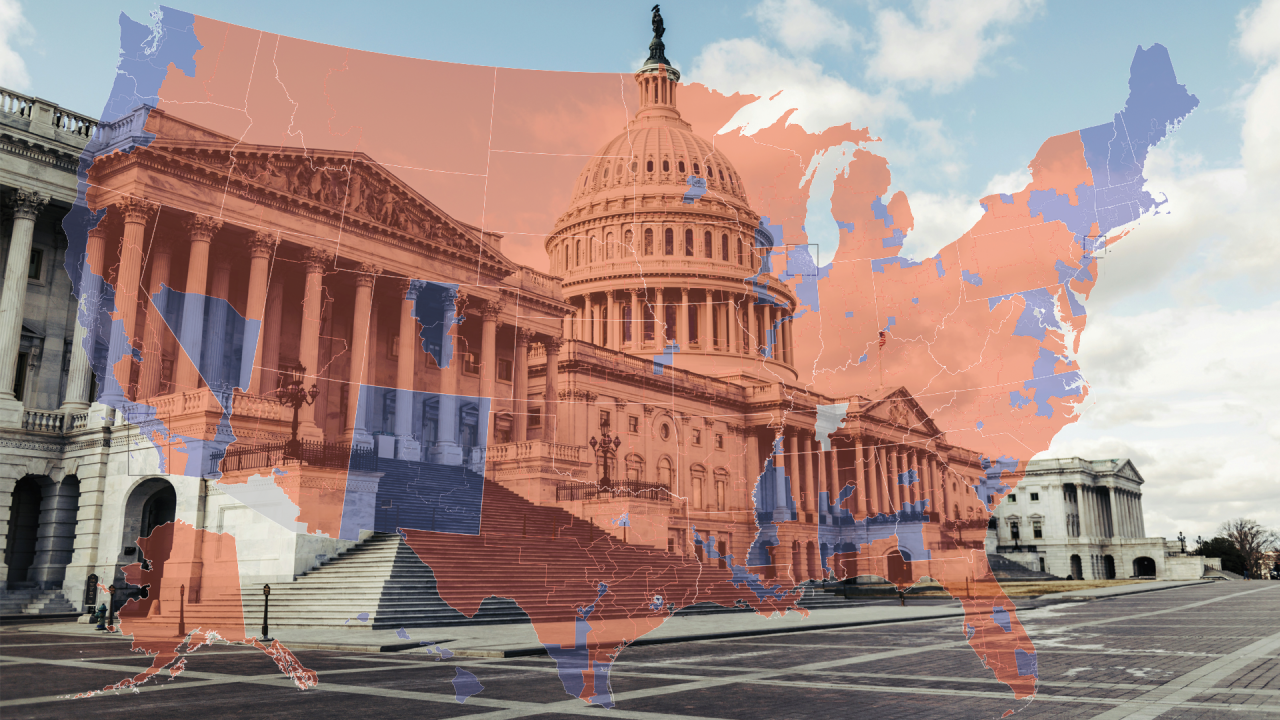
How today's fights over redistricting, gerrymanders and voting rights follow a long tradition of American hardball politics over whose votes count


It began with Texas Democrats fleeing the state. The proposed legislative districts in the state would tilt the U.S. House of Representatives balance of power in Republicans’ favor. California Governor Gavin Newsom responded with his own plan to redistrict to make up for any national seats Democrats lose in Texas.
The political standoff over redistricting is making headlines across the nation for its potential to reshape political power in next year’s mid-term elections and beyond.
“The national parties are looking for opportunities to pick up seats wherever they can,” said Erik Engstrom, a professor of political science in the College of Letters and Science at UC Davis. “Because voters are very loyal partisans nowadays, it's hard to change voters’ minds, so if you want to win national power one strategy is to try and tweak district lines.”
The redrawn voting districts in Texas, recently passed by the state legislature, weren’t in response to a change in demographics. Their purpose was purely political, making them part of a long tradition of partisan hardball dating back nearly to the nation’s founding. As happened in the past, the result of this national battle unfolding in state legislatures could have lasting impacts on our political future.
What is redistricting in state legislatures?
Redistricting is the process of grouping voters who elect their representatives at the local, state or federal level. For example, every elected member of the U.S. House of Representatives is elected by voters within their legislative district.
The U.S. Constitution’s Article 1, Section 4 gives states almost complete control over how voters elect their own Senators and Representatives. This includes how — and how often — states redraw districts.
There are some limitations when it comes to redistricting. Based on the 1962 Supreme Court case Baker v. Carr, states must establish electoral districts of equal population for the U.S. House of Representatives and state legislatures. The districts have to be compact, which means that they can’t stretch across the state. Districts must also be contiguous.
"You couldn't have a district that's part of Los Angeles and part San Francisco and nothing connecting them," said Engstrom.
A long history of gerrymandering in the U.S.
Gerrymandering is the intentional manipulation of district lines for partisan gain. There is no strict, legal definition of gerrymandering according to the U.S. Supreme Court, said Engstrom. His book Partisan Gerrymandering and the Construction of American Democracy examines whether the rules that govern how people elect their leaders should be made free from political influence.

March 26, 1812.
Courtesy American Antiquarian Society.
Gerrymandering has a long history in the U.S. The term “gerrymander” gets its name from Massachusetts Governor Elbridge Gerry, who in 1812 signed a bill creating new districts in his state. One district had the shape of a salamander, inspiring a political cartoon in the Boston Gazette by illustrator Elkanah Tisdale with the headline “The Gerry-mander.”
The practice of gerrymandering, or redistricting by political parties in power to improve their future odds, stretches back to 1788, said Gregory Downs, a constitutional scholar who is a professor of history and the chair of the department. The Federalist Party, the party of then-president George Washington, grouped together anti-Federalist congressional districts in Virginia in order to keep a majority of seats in Congress.
When Republican Thomas Jefferson overcame Federalist John Adams to win the election of 1800, Jefferson’s party changed the rules in a different way. They reverted to a “general ticket,” which meant that whichever party took control of the presidency also won every congressional seat in every state they won.
“There's this kind of back and forth in the middle of decades at the time, and it became a part of how political parties positioned themselves and fought,” said Downs. “That doesn't mean it worked well or was fair or didn't have other problems, but it is part of early American history.”
The last time state redistricting stripped voting rights
Engstrom said that a key argument for giving individual states the power to manage national elections is to make elections overall more democratic. But there are downsides to this.
“Probably the most obvious and predominant downside to letting states run their own elections is that states can tyrannize a minority within the state unless the federal government steps in and stops them,” said Engstrom.
This happened immediately following the Civil War, when redistricting and other technical changes to voting effectively disenfranchised Black voters for 100 years.
Engstrom’s book especially documents the outsized influence gerrymandering had on politics between 1870 and 1900. During that time, national party leaders wrote letters to state governments asking that they redistrict because their majority in the U.S. House of Representative was in jeopardy. Ohio in particular was a hotbed of redistricting, he said, with both parties rushing to redistrict as soon as they assumed power.
Just like now, the margins between Democrats and Republicans in the House of Representatives was so close that they were looking for any opportunity to pick up a few seats here and there.
— Erik Engstrom
On the national level, these efforts worked. The Democratic Party, which was then the party of the South and the former Confederacy that had lost the U.S. Civil War, returned to power. Immediately they set out to dismantle reconstruction efforts that had assured voting rights for newly freed Black Americans.
The battle over redistricting and voting rights today
The Voting Rights Act of 1965 is one way the federal government has stepped in to oversee elections. The Act was written to undo the many ways Black Americans were prevented from voting after reconstruction was dismantled.

“It was predominantly conceived as a way of addressing Black disfranchisement in the South, and yet it has expanded to address disfranchisement or disempowerment of other racial groups and of language minority groups,” said Downs.
Redistricting has been central to a number of challenges to the Voting Rights Act. The Act made it mandatory that states with a history of discrimination receive “preclearance” from the Department of Justice or a court before changing voting rules — which includes legislative districts. The 2013 Supreme Court decision in the case Shelby County v. Holder ended this requirement.
Challenging a gerrymander on the basis that it discriminates against voters’ political party preferences is no longer viable since the 2019 Supreme Court ruling in Rucho v. Common Cause.
It might still be possible to challenge a gerrymander on the basis of racial discrimination, which would violate the Voting Rights Act. Right now, pending cases charging racial discrimination in redistricting efforts include one from Louisiana that argues a 2022 district map diluted the votes of Black residents.
Redistricting and the future of U.S. political power
Today’s redistricting in Texas is unique because it redraws districts mid-decade, without new population data from the U.S. Census Bureau that is typically the reason for new maps. It’s also unique because the Texas legislature took up redistricting in response to the President’s request with a stated desire to gain Republican seats in the House of Representatives in the 2026 mid-term election.

(Source: Texas Legislative Council)
There are key differences between the U.S. today and as it was in the 1800s that could supercharge this style of politics. Political parties now have much more comprehensive voter and geographical data as well as computers to model districts as statistically foolproof as possible.
“The technology and the ability to do it effectively has transformed,” said Downs.
At the same time, some states are drawing back from prior efforts to take the politics out of drawing legislative districts. California, New York and a handful of other states have politically independent commissions that oversee the creation of legislative districts.
In response to Texas, this independence may end. In August, California Governor Gavin Newsom signed into law a redistricting plan designed to increase Democrat-held seats in the House of Representatives. The plan will need voter approval in November.
The irony is that, on the whole, Democratic states have been much more open to the idea that partisan gerrymandering, even if it's not on racial grounds, is a problem.
— Gregory Downs.
There are no guarantees these efforts, in either Texas or California, will have the intended result. The U.S. is incredibly polarized politically. The margin for error is as thin as the margins between Republican and Democrat voters nationwide. The President won the popular vote in 2024 by 1.47% across 152.3 million total votes.
“They could do what's called a ‘dummymander’ where you divide up districts in a way that benefits the other party,” said Downs.
YOU MAY ALSO LIKE THESE STORIES

A Brief History of Citizenship in the 14th Amendment to the U.S. Constitution
Historian Gregory Downs explains the complicated history of the 14th Amendment to the Constitution, including subsequent laws that undermined equal protections it guaranteed, as well as the court case affirming the definition of birthright citizenship we take for granted today.

Political Polarization is Not Unique to the U.S., but its Causes Are
Hostility for people in opposing political parties in the U.S. has been increasing for decades. Research in political science is at the frontier of more detailed measures of polarization that show what drives those feelings. This research provides insight on what might change the course of the nation.