




Michael Oskin was camping with his friends atop San Gorgonio Mountain, southern California’s highest peak, when the infamous Lander’s earthquake struck just before 5 a.m. on June 28, 1992. As aftershocks from the 7.3 magnitude earthquake rolled through the campsite, trees shook and rocks tumbled down slopes. Without cellphones to figure out what was going on, the group decided to hike back down the mountain towards civilization.

“It seemed like every time we stopped, there was an aftershock,” Oskin recalled.
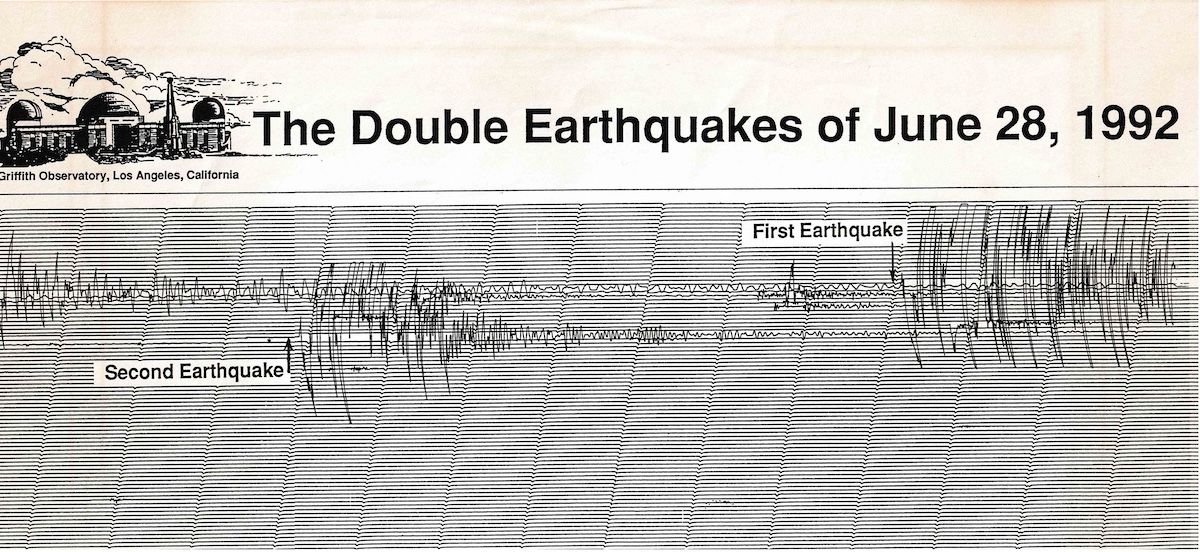
As the group reached the bottom of a hill, Oskin stopped. Something was off. A loud boom sounded, and the earth began to violently shake again as a separate but related magnitude 6.5 earthquake struck. The time was 8:05 a.m.
“It was so violent we could not stand up. My friends and I were all grasping onto this tree,” Oskin said. “There were trees snapping, boulders coming down the hill, it was really traumatic.”
But the experience also sparked a fascination in Oskin, who at the time was 19 years old and studying geology at University of California, Los Angeles. It kickstarted a lifelong interest in the science of earthquakes.
Today, Oskin is a professor in the Department of Earth and Planetary Sciences at the College of Letters and Science at UC Davis. Through field observations, high-resolution topography and various geochronological techniques, Oskin is studying the relatively recent geological record (think the last 100,000 years) to better understand the tectonic processes and crustal deformations surrounding earthquakes.
“Topography connects us to earthquakes because the repeated slip of faults over time will build topography or at least disrupt it,” Oskin said to the audience gathered at G Street WunderBar for the August Davis Science Café.
After sharing his earthquake origin story with the audience, Oskin led a conversation titled “Earthquakes in California: What Might the Next ‘Big One’ Be Like?”
The conversation revolved around four points:
- The next “Big One” is inevitable
- It’s a matter of location
- It will probably be smaller than the last “Big One”
- The “Big One” is not overdue

What is the “Big One” in California and why is it inevitable?
When you hear the term “Big One” in reference to California earthquakes, it usually refers to a hypothetical, cataclysmic earthquake of nearly 8.0 magnitude that will occur sometime in the future. But it’s also a term used synonymously with similarly large earthquakes of the past, such as the 1857 Fort Tejon earthquake in southern California or the 1906 San Francisco earthquake.
In the past, technology limited our understanding of these earthquakes, but revolutions in geology over the past few decades, including advances in laser-based remote sensing technology, have opened a window to viewing plate tectonic motion preserved in the landscape.
Thanks to this, among other advances such as GPS, geologists know that fault slip rates and fault loading rates beneath California match. The San Andreas Fault has a slip rate of about 3.5 centimeters per year, Oskin said, highlighting an area of the fault near Carrizo Plain National Monument in San Luis Obispo County.
“Over time, that loading of the fault has to be balanced out by the fault slipping,” Oskin said. “And the last time the fault slipped here was 1857 and that was like six or seven meters.”
Oskin likened these geological processes to a compressed spring or stretched rubberband. Small movements put pressure on the spring and rubberband, but eventually both snap back, which are much bigger movements.
The same can be said for earthquakes, and those big releases of elastic energy can be catastrophic.
Where could California’s next “Big One” happen?
According to Oskin, where the strongest shaking from an earthquake occurs depends entirely on proximity to the earthquake’s causative fault and its rupture.
To illustrate this point, Oskin referenced the 1906 San Francisco earthquake and the 1868 Hayward earthquake. Despite the San Francisco earthquake being stronger — 7.9 magnitude versus roughly 6.9 magnitude — the Hayward earthquake was more inland due to the placement of its causative fault.
“Location really matters and in fact, this 1868 earthquake also shook Davis more strongly than the 1906 [one]. The 1906 one, though, was much longer,” Oskin said.
But magnitude is still of paramount importance.
“The big ones matter,” he said. “To put it another way, you would have to have a magnitude 6.0 [earthquake] every month to make up what one magnitude 8.0 does every 200 years. So it’s actually kind of good we get large earthquakes because they’re kind of rare, whereas a magnitude 6.0 can cause a lot of havoc, and if it’s happening every month somewhere in California, we’re always going to be in panic mode.”

Why the next “Big One” could be smaller than the last
The magnitude of an earthquake correlates strongly to the length and amount of slip in its causative fault rupture. Oskin showed the room a graph of earthquakes and their respective fault lengths.
In California, “we see kind of a flipping between very long, really large earthquakes and ones that are still big, but not quite as big,” Oskin said. “When we look at the San Andreas [Fault], a lot of the earthquakes were shorter than the last one that happened.”
He noted that the 1857 Fort Tejon earthquake rupture was over 300 km in length. Statistically, most of the earthquakes that occur along the San Andreas Fault in California fall in the 100 km range, according to Oskin.
“So most of the earthquakes the San Andreas produces are partial ruptures,” Oskin said. “Most of the things that happen are smaller than what we’ve seen historically.”
Is California’s next “Big One” overdue?
Oskin’s answer to this question boiled down to statistics and semantics.
“Statistically, that’s just untrue,” he said in reference to the term “overdue.”
“What happens is large earthquakes will become a ‘little more due’ every year, and it’s better to think about it that way than to think…we’re somehow overdue and we should be panicking,” he added. Still “that threat grows a tiny bit every year the longer it’s been since the last [Big One].”
Since the 1906 San Francisco earthquake, no earthquake in the region has reached the “Big One” level. The destructive 1989 Lomo Prieta earthquake, which many in attendance at the Davis Science Café experienced, was 6.9 in magnitude, nearly a point away from “Big One” status.
Oskin displayed various probability graphs for assessing earthquake hazard and risk, but he focused on a specific one called a Weibell distribution and the information researchers have gleaned from it.
“It’s been 120 years since 1906…we’re at about a 0.3% per year hazard,” Oskin explained. “The southern San Andreas though, it’s been 169 years since 1857, and the hazard is somewhere around 1.5% to 2% per year.”
Why can’t scientists predict earthquakes yet?
Even with all this statistical data, sound earthquake prediction remains elusive. The tricky part, Oskin said, is identifying an earthquake’s origin point.
“The process of an earthquake starting occurs 10 miles down in the earth,” he said. “No amount of money is going to get us down there easily to observe anything useful.”
And “once the earthquake starts that just half the story,” he added. “We don’t know how it stops.”
Even the earthquake early warning system isn’t proper prediction. Instead, the system only sends warnings once an earthquake has started and does so to those based on an algorithm that determines who might be affected.
“I do worry — I’m not alone in this — that people are going to feel disappointed in the earthquake early warning when a really big earthquake happens,” Oskin said. “Because, if it happens right beneath you, you’re not going to have any warning. It’s just going to erupt into chaos.”
YOU MAY ALSO LIKE THESE STORIES

Tiny Earthquakes Reveal Hidden Faults Under Northern California
By tracking swarms of very small earthquakes, seismologists are getting a new picture of the complex region where the San Andreas fault meets the Cascadia subduction zone, an area that could give rise to devastating major earthquakes.

Video: Why Earthquake Science Matters
UC Davis observational seismologist Amanda Thomas discusses the causes of the June 2026 Venezuela earthquakes, why earthquake science matters and how her research is helping us learn more about the tectonic shifts beneath our feet.