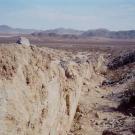
At the August Davis Science Café, Michael Oskin led a conversation titled “Earthquakes in California: What Might the Next ‘Big One’ Be Like?” Through field observations, high-resolution topography and various geochronological techniques, Oskin is studying the relatively recent geological record to better understand the tectonic processes and crustal deformations surrounding earthquakes.
In this video, UC Davis observational seismologist Amanda Thomas discusses the causes of the Venezuela doublet, why earthquake science matters and how Thomas’ research is helping us learn more about the tectonic shifts beneath our feet.
By tracking swarms of very small earthquakes, seismologists are getting a new picture of the complex region where the San Andreas fault meets the Cascadia subduction zone, an area that could give rise to devastating major earthquakes.
Earthquake faults deep in the Earth can glue themselves back together following a seismic event, according to a new study led by researchers at the University of California, Davis. The work, published Nov. 19 in Science Advances and supported by grants from the National Science Foundation, adds a new factor to our understanding of the behavior of faults that can give rise to major earthquakes.
The July 29 earthquake on Russia's Kamchatka peninsula was among the most powerful recorded by modern instruments, setting off tsunami warnings around the Pacific rim. John Rundle, Distinguished Professor in the departments of Physics and Astronomy and of Earth and Planetary Sciences at UC Davis, had previously included the Kamchatka region in an analysis of earthquake risk published in 2018.
As the inaugural Louise H. Kellogg Endowed Chair in the Department of Earth and Planetary Sciences (EPS) at UC Davis, Amanda Thomas will advance scientific excellence in geophysics through visionary leadership at UC Davis and expand the reach of geosciences by teaching and mentoring both undergraduate and graduate students.
Chijun Sun, an assistant professor of earth and planetary sciences at the College of Letters and Science, recently returned to land after a months-long trip aboard the Chikyu, a deep-sea scientific vessel investigating the seafloor following a massive 2011 earthquake and tsunami.
Magali Billen, a professor in the Department of Earth and Planetary Sciences, seeks to unravel the forces that drive plate tectonics from hundreds of kilometers beneath the Earth’s surface. Specifically, she’s interested in subduction zones — areas where two tectonic plates collide, causing one to dive back down into the Earth’s mantle.