




A baby’s focus may seem brief, but some words and gestures do a better job of keeping their attention on their surroundings even before they say their first word.
A new study from the University of California, Davis, finds that combining words that label objects, such as “bear,” with spatial words such as “here” or “there” captures infants’ attention for longer than using those types of words alone or using other words that are neither labels nor spatial. Adding gestures, such as pointing, holds babies’ attention the longest.
The study, the first believed to measure associations between spatial words and infants’ attention, was published online Sept. 1 in the journal Developmental Psychology.
“This study finds that the diversity and specificity of the words parents use can shape their babies’ development in their engagement with objects around them,” said Erim Kızıldere, the study’s lead author and a Ph.D. student in psychology in the College of Letters and Science at UC Davis.
Tracking how long a baby looks at a bear
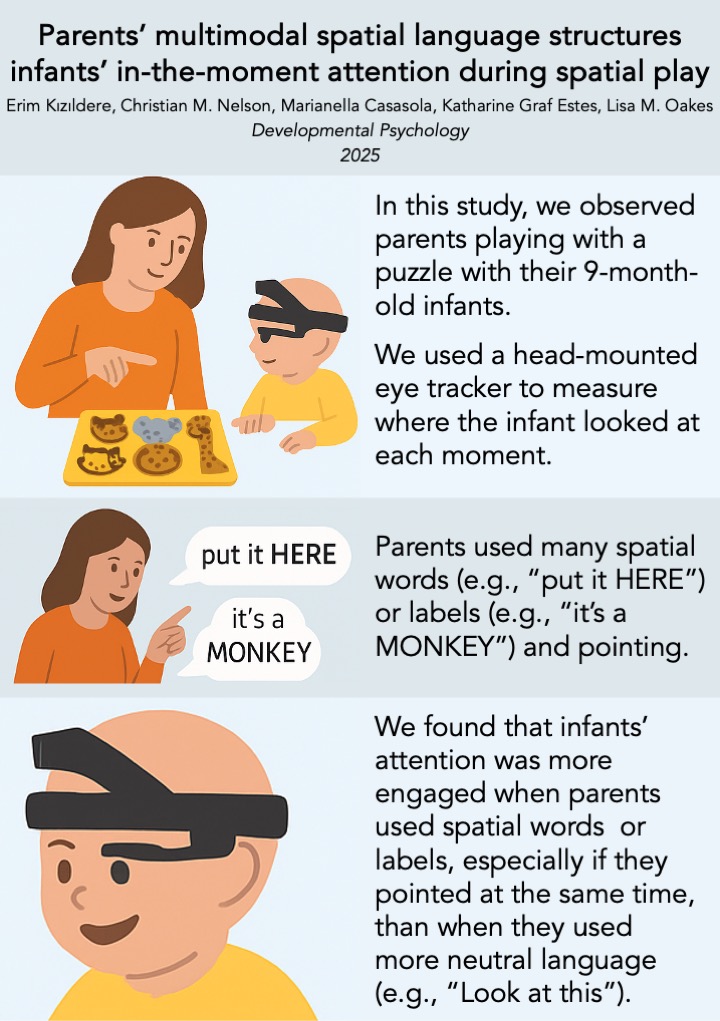
The research took place in the Infant Cognition Lab at the UC Davis Center for Mind and Brain, led by Lisa Oakes, Distinguished Professor of psychology and senior author of the study. Between 2016 and 2017, the research team observed parents and their 9-month-old infants playing together with a puzzle that had cartoon images of a parrot, zebra, lion, monkey, bear and elephant.
The infants wore head-mounted eye trackers that measured where they looked at each moment and for how long.
“At nine months old, infants are just starting to develop a sense of the space around them as well as some of the words to describe it,” said Oakes. “Because parents used a lot of spatial language, we had the opportunity to measure how babies respond to it.”
When parents used words that were neither labels nor spatial, the infants focused their attention for an average of 3.1 seconds. With labeling words, such as “lion,” infants focused for 3.9 seconds, on average. With spatial words, such as “here” or “there,” infants focused for an average of 3.6 seconds.
Using both labeling and spatial words held babies’ attention the longest, at an average of 6.1 seconds. If these labeling and spatial words were accompanied by their parents’ gestures, such as pointing, the infants focused their attention for an average of 8.4 seconds.
The study included 49 North American caregivers and their 9-month-old infants.
Understanding space early
The research team chose 9-month-old infants because at that age they can follow someone’s gaze and have their attention directed to an object, they said.
Paying attention for longer in moments when parents use labeling and spatial words combined with gestures might improve how babies understand the way objects exist and move in space, researchers said.
“When infants focus their attention longer on the objects around them, those experiences can build up and may lead to better spatial reasoning later in their lives,” said Kızıldere.
Co-authors on the study included Christian M. Nelson, Ph.D. candidate, psychology and Katharine Graf Estes, associate professor of psychology and affiliate of the Center for Mind and Brain, both of UC Davis; and Marianella Casasola, professor of psychology, Cornell University. The study was funded in part by the National Science Foundation.
Read more stories like this on the UC Davis website.
YOU MAY ALSO LIKE THESE STORIES

Toddlers' Eye Movements Predict Ability to Judge Memories, New Research Suggests
New research from the University of California, Davis, has found that toddlers who tend to look more closely at and compare paired images during a memory task are more aware of the accuracy of their own memories a year later. This finding connects the earliest process of seeking information with the developing ability to judge the accuracy of memories.

New Research on Attention Seeks to Expand Tools to Support Children and Adults with Attention Deficits
Attention deficit hyperactivity disorder (ADHD) is the most common childhood behavioral disorder. A research collaboration between the Center for Mind and Brain and the UC Davis School of Medicine are using virtual reality to understand ADHD better, which could improve its diagnosis and treatment in children and adults.