




This article originally appeared on the Substack Pacific, Mountain, Bridge
Walking through the main square of Aleppo’s Shaykh Maqsud neighborhood, architect and cultural heritage preservationist Sozdar Abdo looked at what wasn’t there and told me, “This was the greatest blow to Syrian Kurdish identity and community.”
In late January, fierce fighting between Syria’s new Islamist government and Kurdish militias of the Syrian Democratic Forces, or SDF, had left the neighborhood in ruins and ended more than a decade of self-rule. The government banned Kurdish political activity and cultural expression and stripped the streets and public spaces of any physical reminder that this part of Syria had once been a safe haven for Syria’s largest minority.

January’s fighting was both a final battle in Syria’s civil war and the first fight in a larger struggle over conflicting visions for the country’s future. Despite recent concessions to Kurdish demands for civil and cultural rights, the version of Syria’s future on display in Shaykh Maqsud is not one that respects human rights and values diversity.
Instead, it’s a bleak, socially rigid and theocratic one, like what I saw in the city of Idlib where Islamist control has been absolute since 2015: at most, minorities are tolerated as not-quite citizens and women are excluded from public life. Shaykh Maqsud, on the other hand, had been a kind of experiment in how a new Syria could embrace the inherent differences of its peoples and build a successful society.
A neighborhood in, but not of Aleppo.
To get to Shaykh Maqsud from central Aleppo, you first travel northwest along the Quwayq River’s concrete channel, turn left and go up a hill. The husk of the al-Hassan Mosque, gutted and repurposed as a firing position, towers over the approach. The neighborhood is about a hundred years old and is among the “new” suburbs of a city that has been continuously occupied since the 3rd Millennium BCE.
From the beginning of the Syrian civil war, the neighborhood had remained autonomous from the rest of the city. Yekîneyên Parastina Gel, or “People’s Defense Units,” a Kurdish militia associated with the Kurdistan Workers Party, or PKK, and later the United States military, occupied it.
The neighborhood was administered by a civilian and woman-led local coordinating committee that had representation from Kurds, Armenians, Turkmen and Assyrians. People built new parks, opened schools and cultural centers and engaged in forms of political education and discourse, primarily in Kurdish, but also Arabic. In addition to civilian leadership, women served in the militias and police force.
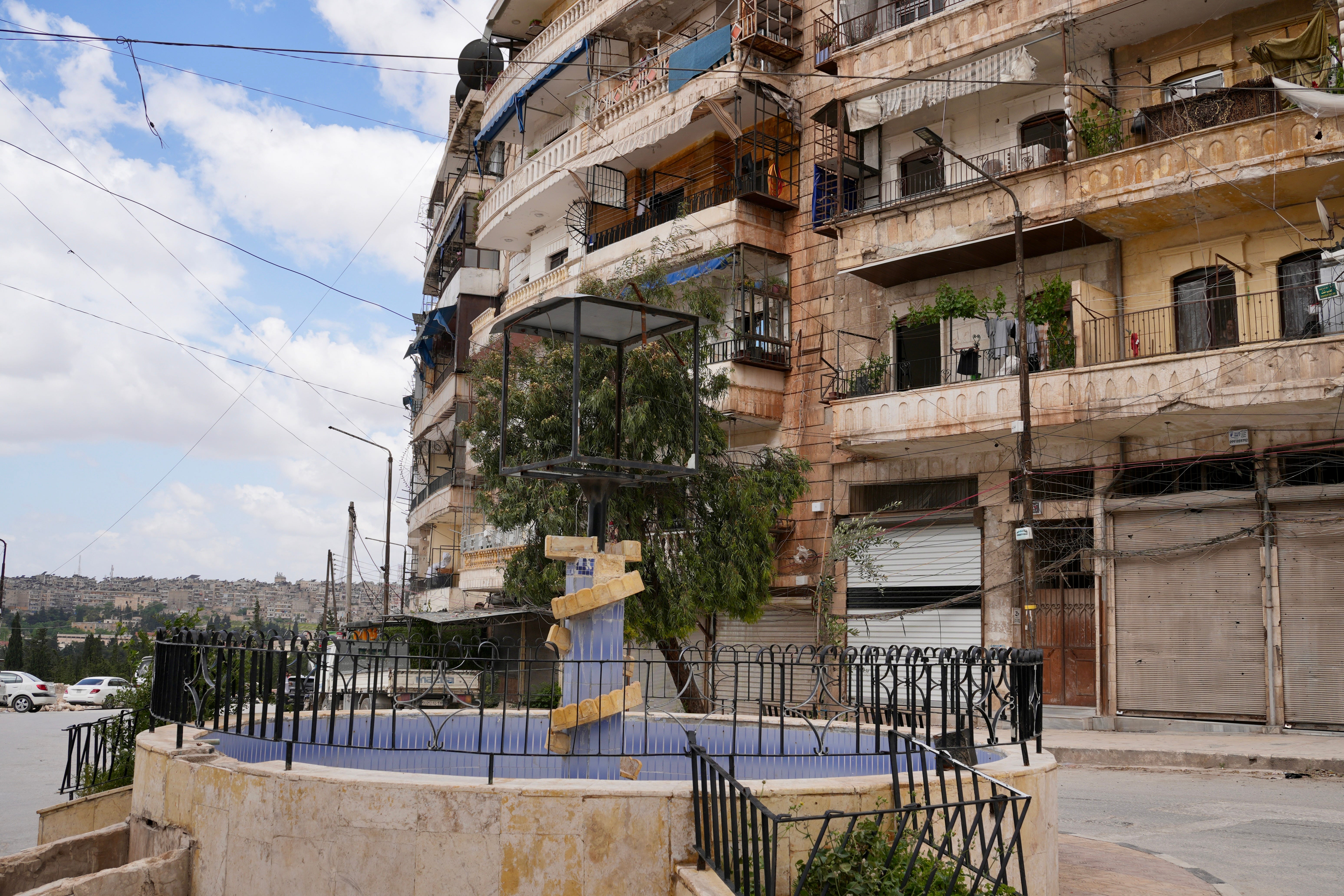
Separated from the other parts of Syria under Kurdish control, like the Rojava enclave along the border with Turkey, Shaykh Maqsud was just one neighborhood among many in Syria’s largest city and remained connected with it socially and commercially through the war. Its nearness to the city and its physical location atop a hill overlooking downtown made it strategically important and a political problem for both their sometime ally, the Syria’s Baathist régime, and Islamist rebel groups, especially those backed by Turkey.
In the late 1920s, American humanitarians, believing the air and distance from the city would be good for the Armenian and Assyrian Genocide refugees living in Aleppo’s squalid camps, settled families there. It was also home to a community of Sufis of the Qadiri order who preferred to practice their mysticism at a distance from the disapproving eyes of Sunni religious officials. With time, they called the district Our Lady of the Mountain, al-Sayida for short, in reference to a small Catholic church of that name.
Through the 1970s, Kurds, primarily from the agricultural areas northwest of Aleppo like Afrin, came to the city in search of work and better schools for their children. While many Armenians and Assyrians moved to higher-quality apartments in the upscale Aziziyya or Midan neighborhoods, the city had retained its multi-ethnic character even when I lived nearby in the 1990s. I remember it as a fun, open and comfortable place, with a great nightlife and bustling shops.
Recognizing the historical and cultural diversity of places like Shaykh Maqsud when I first visited Aleppo as a Fulbright scholar in 1993 is what had made me want to write my dissertation about the city’s history in the early 20th century. When I wrote my first book, Being Modern in the Middle East (Princeton, 2006), I was writing against a more common view of the Arab Middle East as religiously and socially monolithic, a view even many specialists of the region maintain even now.
Finding Shaykh Maqsud
Shaykh Maqsud has always been a neighborhood of migrants and refugees; during the war, to that number was added young men fleeing forced military service and political and religious dissidents.
As Sozdar and I continued to wander the center of town, we noted how complete the erasure of Kurdish identity was after the government forces took the neighborhood. It wasn’t haphazard, but a conscious and intentional act. Images from before showed the city festooned with the white, green, red and yellow banner of the Kurdish movement and images of the PKK’s Abdullah Öcalan.

The current masters of Syria are intent on bringing their narrative of the history of the civil war to the center of public consciousness, marginalizing any other version. This state act of stripping public spaces is no different and perhaps worse in that it sends a coercive message about what can and can’t be remembered.
The neighborhood, like many others in Aleppo, is receiving little to no support to rebuild or reestablish public services, including trash collection, water, sewage and electricity. Small NGOs provide some assistance, but beyond that, the inhabitants are on their own.
Sozdar is part of a larger effort to restore the fabric of Aleppo’s old city — a UNESCO World Heritage Site — which was largely destroyed by war and fire. “To live in a city that is working to rebuild its heritage,” she told me later, “when yours is being demolished by the people of the same city, can leave your soul in pain.”
She remembers how vicious the online attacks on the Kurds of Shaykh Maqsud had been in January, and she was left at a loss as to why the other communities in the city could not understand Kurdish demands for decentralization and cultural rights. “It’s just straining and mind-consuming,” she concluded.
Violence against dead Kurdish women
At the northernmost end of Shaykh Maqsud is the Cemetery of the Martyrs of the Resistance of Aleppo — Şehîden berxwedana Helebê in Kurdish. It was also home to a veterans’ recreation center with small garden. Here the erasure was different. As government forces took the compound, they overwrote the graffiti images of the allied PKK and YPG militias with the inelegant phrase “tuz,” meaning "fart on you.
The vulgarity visited on the center was amplified at the graveyard. Here are buried Kurdish fighters, men and women, who fell in the line of duty across Syria and fought in battles with Turkish-supported Islamist groups and alongside American forces against the remnants of al-Qaeda.
Many were the victims of targeted assassinations by Turkish military intelligence. In January, following their victory, Syrian government forces systematically destroyed the graves. One after another were smashed by rifle butts and pictures of the dead defaced.
I watched Sozdar survey the scene and take pictures. This was her first time at the cemetery. We were there with other Kurdish and Arab young people who had come of age during the war. They were silent as we walked among the broken cenotaphs and shattered markers.
“It’s just not right. They are the dead. We just don’t do this,” one told me. I had seen this before, especially at the Palestinian Martyrs’ Cemetery in the Damascene suburb of Yarmuk Camp. There though, it was the old régime that killed the dead with barrel bombs dropped from helicopters.
One grave in particular stood out: that of Jiyan Tolhildan, translated as "Life Revenge," nom de guerre of Selwe Yusêf (1983-2022), a senior Kurdish commander and founder of the all-female Yekîneyên Parastina Jin, or Women’s Protection Units, killed in a Turkish drone strike near Qamishli in Syria’s far northeast.
The units were formed to stem the use of rape and abduction as weapons against individuals and entire communities during the Syrian civil war; their establishment was also a response to the 2014-2017 genocide of the Yazidi people of Iraq by the Islamic State. Yazidi women and girls, like Nobel Peace Prize winner Nadia Murad, were taken and sold into slavery.
Female units in the Kurdish resistance highlights a different approach to women in war, one that links military service to citizenship and broader social leadership. Those who desecrated Jiyan’s grave would consider both an armed woman and women in political or military leadership anathema — proof, in their eyes, that God’s laws for mankind were being violated. The viciousness of the attacks on women’s graves was a post-mortem disciplining of heretics.

The graves of women fighters showed a great deal more damage than those of the men, as though they had been singled out for particular violence. Jiyan’s marker had a sculpture of a dove on it. It had been smashed and scattered about. I spent a few moments gathering up the pieces and putting them back in place.
As we left Shaykh Maqsud, we passed by an abandoned railway bridge over the Quwayq beneath which dozens of bodies of Kurdish and Arab men and boys were found in 2013, hands bound behind their backs and shot at close range. This was early in the uprising against the régime, which began as peaceful and only turned violent as the Baathist government turned to the kind of repression witnessed at this bridge.
These hadn’t been armed fighters, but rather a cross-section of Aleppo’s society; perhaps they had voiced opposition or joined a demonstration. The killing was done to send a message. I had gone to see if there were any reminders of what had happened here. Nothing.
I understand the human and humane desire to forget atrocity and move on; memory can terrorize us into inaction and leave us vulnerable to more trauma. Still, when forgetting serves oppression, then it is something much more malign. Syria is at a moment when remembering is becoming dangerous.
YOU MAY ALSO LIKE THESE STORIES:

Why Teaching Difficult Subjects Requires a Framework for Solutions
Keith David Watenpaugh, professor of human rights, guides UC Davis undergraduate and graduate students through the modern world’s greatest tragedies with a focus on empowerment and solutions. Learning this human rights perspective prepares students to lead and promote the good wherever life leads them.

Attacks on Public History and America's National Parks
A visit to Muir Woods National Monument prompts a reflection on the current attacks on public history and Keith David Watenpaugh's past as a National Park Ranger.