UC Davis Professor of Physics and Astronomy Andrew Wetzel has been appointed to the newest class of the U.S. Defense Science Study Group, a program directed by the Institute for Defense Analyses. The program invites outstanding science and engineering professors to apply their skills and research to the United States’ security challenges.
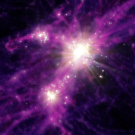
At the February 2026 Astronomy on Tap event at Sudwerk Brewing Co., Andrew Wetzel used supercomputer simulations to take the audience through the 13.8-billion-year history of the Milky Way galaxy.
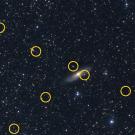
In a study published in The Astrophysical Journal, researchers reveal a markedly different ecosystem from the smaller number of satellite galaxies that circle our Milky Way in the nearby Andromeda galaxy.
Several faculty at the University of California, Davis, are among the recipients of presidential awards for excellence in STEM mentoring and research announced by the White House Jan. 13 and 14.
When researchers glimpsed the first images and data from the James Webb Space Telescope, humanity’s largest and most powerful space telescope, they noticed something peculiar. A large number of bright galaxies deep in the universe formed during a period called “Cosmic Dawn." New research published in The Astrophysical Journal Letters shows that a theoretical model produced roughly five years ago predicted these very observations and credits them to bursty star formation.