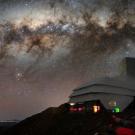
From a mountaintop in Chile, under clear dark skies, NSF–DOE Vera C. Rubin Observatory has begun the revolutionary Legacy Survey of Space and Time (LSST). The ten-year survey is Rubin’s signature campaign to create the most comprehensive, cinematic record of the Universe in history.
An expert in quantum precision measurements, Nancy Aggarwal creates technologies to detect the universe’s unseen phenomena. In her lab, she’s developing two major experimental platforms: a first-of-its-kind gravitational-wave observatory and precision measurement systems for next-generation dark matter searches.
Astronomers using the James Webb Space Telescope have made a surprising discovery about a galaxy long, long ago and far, far away: It isn’t rotating. That’s something only seen in the most massive, mature galaxies that are closer to us in space and time, said Ben Forrest, a research scientist in the Department of Physics and Astronomy at the University of California, Davis, and first author on the paper published May 4 in Nature Astronomy.
At the most recent Astronomy on Tap event at Sudwerk Brewing, Professor Tucker Jones, Department of Physics and Astronomy, describes how the James Webb Space Telescope is being used to pinpoint the cosmic dawn, an early period in the universe’s history when the first stars and galaxies formed.
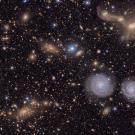
The results of two decades of scientific and technological innovation were unveiled today with the reveal of the first imagery captured by the Vera C. Rubin Observatory, a facility jointly funded by the National Science Foundation and the U.S. Department of Energy's Office of Science.
In a paper published in the Journal of Cosmology and Astroparticle Physics, researchers propose a way to potentially test the anthropic principle, the idea that the universe was tuned to support the evolution of intelligent life.
From March to June 2024, graduate student Arsalan Adil traversed across the northern region of his home country of Pakistan on an adventure that was peppered with science outreach efforts.
Light pollution dampens our view of the stars, hindering our connection to the universe above. It’s one of the reasons why astronomical observatories are erected in remote, often pristine, places. The opportunity to travel to such places drew Lori Lubin to astronomy.
A mathematician working in the life sciences and an astrophysicist studying dark matter from the College of Letters and Science at UC Davis are among the recent cohort awarded Chancellor’s Fellowships for Diversity, Equity and Inclusion. The fellowships recognize exceptional contributions in supporting, tutoring, mentoring and advising underrepresented students and/or students from underserved communities.