Every year, the Bodega Marine Laboratory hosts summer sessions for undergraduate students interested in coastal systems and marine science. During the roughly five-week program, students take classes in topics like coastal oceanography, marine environmental issues and biological oceanography. They conduct fieldwork and go on field trips to nearby sites like the Hog Island Oyster Company. Students can even live at the lab’s on-site dormitory during the session.
In this video, UC Davis marine scientist Elisabeth Sellinger explores the global importance of eelgrass, its role along the California coast, and how the Greater Farallones and Monterey Bay National Marine Sanctuaries help protect and restore these essential habitats.
UC Davis Professor Tessa Hill spoke about the benefits that can come from fast action on methane with the hosts of We Don’t Have Time during this year’s Climate Week NYC, held Sept 21-28. She was joined by Fatima Denton, director of the United Nations University-Institute for Natural Resources in Africa.
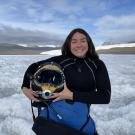
As an assistant diving and boating safety officer for UC Davis based at Bodega Marine Laboratory, Abbey Dias works with UC Davis researchers to coordinate and provide guidance for critical fieldwork that’s helping us understand the health of our oceans and waterways, and in turn, our global climate.
A group of UC Davis researchers recently shared their experiences after completing a four-week field season at Antarctica's Lake Fryxell. The seminar titled “UC Davis in Antarctica” was broadcast via YouTube livestream from Antarctica’s McMurdo Station.
Join Elisabeth Sellinger and Mazie Lewis for a day of seagrass meadow monitoring research in Elkhorn Slough. A nursery habitat for many marine animals, including mammals, shellfish and fish, seagrass meadows are vital ecosystems. But their benefits don’t just touch the ocean-dwellers of our planet.
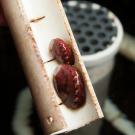
White abalone shells are magnificent structures. Translucent during the marine snail’s juvenile days, the extremely durable shell increases in opacity as the organism ages, gaining its paint-splatter-esque red, brown and white coloring from the algae it eats. But abalone, along with other marine organisms, are facing a crisis, one that affects the integrity of their shells.