In December 2025, Russian scientists published an analysis of a 67-million-year-old dinosaur fossil that was found in the Gobi Desert in 1979. The researchers examining Manipulonyx reshetovi suggested that the species specialized in egg eating, using its stubby digits and long claws to grasp and puncture eggs. A UC Davis researcher is questioning that narrative.
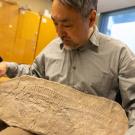
For decades, Ryosuke Motani, a professor in the UC Davis Department of Earth and Planetary Sciences, has teased apart that very question by studying fossils in tandem with leading-edge computational and chemical analysis techniques. His research has led to landmark discoveries, from using eye socket measurements to determine that some dinosaurs were nocturnal to revealing how land animals adapted to the ocean, among a host of other discoveries.
Working in the lab of Professor of Earth and Planetary Sciences Ryosuke Motani, doctoral candidate Benjamin Faulkner is exploring how plant-eating developed in diapsids, a lineage that includes dinosaurs and modern day lizards, snakes, turtles, birds and crocodilians.