At the April Davis Science Café, environmental toxicologist Andrew Whitehead explored not only how our actions as a species affect ourselves, but also how they impact the innumerable species we share the Earth with.
In December 2025, Russian scientists published an analysis of a 67-million-year-old dinosaur fossil that was found in the Gobi Desert in 1979. The researchers examining Manipulonyx reshetovi suggested that the species specialized in egg eating, using its stubby digits and long claws to grasp and puncture eggs. A UC Davis researcher is questioning that narrative.
In a new paper appearing in the Proceedings of the National Academy of Sciences, Vermeij and his research colleague Tracy Thomson catalogued the features of various mollusks in the fossil record and found that early mollusks evolved a unique physical trait once every 2 million years. That frequency began declining roughly 444 million years ago to about one new feature every 9 million years.
David Gold specializes in molecular paleontology, an area of study that combines geological, genetic and developmental tools to study the early evolution of animal life. A biologist by training, he’s fascinated by the development of life systems over long time scales.
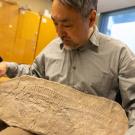
For decades, Ryosuke Motani, a professor in the UC Davis Department of Earth and Planetary Sciences, has teased apart that very question by studying fossils in tandem with leading-edge computational and chemical analysis techniques. His research has led to landmark discoveries, from using eye socket measurements to determine that some dinosaurs were nocturnal to revealing how land animals adapted to the ocean, among a host of other discoveries.
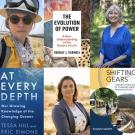
Knowledge about the Earth and its environment is woven throughout these new books, including two from College of Letters and Science faculty, that came out in 2023 or are about to be published. From oceans, fire and evolution to transportation and sustainability, these books inspire action on the world’s most pressing environmental issues.
Working in the lab of Professor of Earth and Planetary Sciences Ryosuke Motani, doctoral candidate Benjamin Faulkner is exploring how plant-eating developed in diapsids, a lineage that includes dinosaurs and modern day lizards, snakes, turtles, birds and crocodilians.