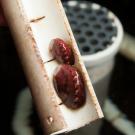
In the lab of Professor of Chemistry Davide Donadio, physical chemistry graduate student Maggie Berrens investigates the fundamental properties of the ice surface to better understand how ice acts as a catalyst for environmental reactions.
Javier Aztiazarain was at a crossroads in his life. For years, he’d worked as an engineer for a production company, designing and building stage shows and live events for clients across the entertainment and sports industries. While he enjoyed the work, Aztiazarain wasn’t satisfied. He wanted to move in a different professional direction, one that still fed his love for design and tinkering tendencies.
Chemistry is in the spotlight this March with the celebration of the 24th Annual R. Bryan Miller Symposium. The event, scheduled for March 14 and 15, features a lineup of lectures from prestigious scientists working at the cutting-edge of chemistry, its subdisciplines and related fields. Registration for the event, which is free, is now open.
White abalone shells are magnificent structures. Translucent during the marine snail’s juvenile days, the extremely durable shell increases in opacity as the organism ages, gaining its paint-splatter-esque red, brown and white coloring from the algae it eats. But abalone, along with other marine organisms, are facing a crisis, one that affects the integrity of their shells.
When it comes to the architecture of the human genome, it’s only a matter of time before harmful genes arise in a population. These mutations accumulate in the gene pool, primarily affected by a population’s size and practices like marrying within a small community. New research published in the Proceedings of the National Academy of Sciences (PNAS) journal provides rare direct evidence showing that increased homozygosity leads to negative effects on fertility in a human population.
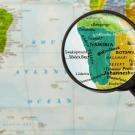
A UC Davis doctoral candidate investigating the hydrochemistry of southern Africa’s largest and most precious freshwater wetland was recently selected as a winner of the National Geographic Society’s 2023 Wayfinder Award. Goabaone Jaqueline Ramatlapeng joins 14 other trailblazers who were selected for their exemplary achievements in exploration through science, education, conservation, technology and storytelling.