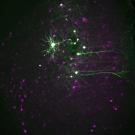
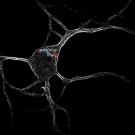
In new research led by the University of California, Davis, researchers found that non-hallucinogenic versions of psychedelic drugs promote neuroplasticity through the same biochemical pathway as psychedelics. However, unlike psychedelics, they don’t activate genes long thought to be key players in that process.
New research shows that the anti-anxiety and hallucinogenic-like effects of a psychedelic drug work through different neural circuits. The study, in a mouse model, shows that it could be possible to separate treatment from hallucinations when developing new drugs based on psychedelics.
Earlier this year, a team of researchers from the UC Davis Institute for Psychedelics and Neurotherapeutics revealed in Science that psychedelics spur cortical neuron growth by activating intracellular pools of 5-HT2A receptors. This neuroplasticity combats the withering dendritic spines characteristic of several neuropsychiatric disorders.