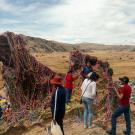
How do pilgrimages get established? How do people become convinced to try something new? Using a theoretical game model, University of California, Davis, anthropologists suggest that lucky outcomes can sometimes give rise to the perception that a new site cures, blesses, grants miracles or otherwise produces great outcomes in pilgrims’ lives.
Archaeologists have long thought that monumental architecture were products of societies with power structures, including social hierarchy, inequality and controlled labor forces. In new research, researchers report evidence of monumental structures built by hunter-gatherer groups at Kaillachuro, a collection of burial mounds located in the Titicaca Basin of the Peruvian Andes.
How do pilgrimages and rituals arise? How do people become convinced to try something new? What makes a place so special that it persists through time, drawing people to it again and again? UC Davis anthropologists Cristina Moya and Nicolas Restrepo Ochoa are answering these questions at the ground floor.