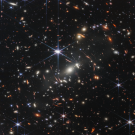
At the most recent Astronomy on Tap event at Sudwerk Brewing, Professor Tucker Jones, Department of Physics and Astronomy, describes how the James Webb Space Telescope is being used to pinpoint the cosmic dawn, an early period in the universe’s history when the first stars and galaxies formed.
In the past, identifying gravitational lenses in the night sky was an incredibly cumbersome task. It required sharp eyes, time and the drive to sift through tens of thousands of images gathered by telescopes. But within the last five years, researchers like Tucker Jones, through collaboration with computer scientists, have started employing machine learning algorithms to identify gravitational lens candidates in the sky.
At the College of Letters and Science at UC Davis, researchers are using the power of machine learning to help protect us from the next pandemic, discover and build new materials, and explore the myriad galaxies in the heavens above.
Three faculty members acclaimed for educational leadership are recipients of the 2024 College of Letters and Science Teaching Awards. The annual awards recognize outstanding teaching of all kinds: at the undergraduate and graduate level, and inside and outside the classroom.
Three faculty members from the College of Letters and Science are among UC Davis' newest class of Chancellor's Fellows, a title given to early career academics doing exemplary work. The Chancellor’s Fellows program was created in 2000, and this year’s class brings the total number of recipients to an even 200. Recipients carry the title for five years and are awarded $25,000 in unrestricted philanthropic support for research or other scholarly work.