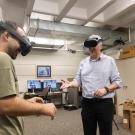
Imagine a virtual space in which an AI instructor effectively guides students through an interactive lesson plan, like building an electronic circuit. Students in remote locations or who need extra stimulation can receive instruction from a virtual agent that can meaningfully communicate with them using verbal and nonverbal methods. This is what Michael Neff is doing in his lab at UC Davis.
Attention deficit hyperactivity disorder (ADHD) is the most common childhood behavioral disorder. A research collaboration between the Center for Mind and Brain and the UC Davis School of Medicine are using virtual reality to understand ADHD better, which could improve its diagnosis and treatment in children and adults.
A UC Davis research team in the Department of Communication is studying how children learn in a virtual reality environment. They recently opened this research to public participation at the Museum of Science and Curiosity, or MOSAC, in Sacramento, where undergraduate research assistants played a key role in making this research possible.