



A celebration of independence and community in New York City


It was a warm yet breezy week in New York City and the sidewalks were full of tourists, many coming for nearby World Cup festivities, others to celebrate Pride, Juneteenth and, especially, the city’s own Knicks basketball team’s historic win. But for students visiting from UC Davis, highlights of the week were largely concentrated in Midtown Manhattan and the Theater District.
“Everything is loud and bright and overstimulating, and so much is happening all the time,” said Janevah Dorestin, who is entering her third year at UC Davis. “For me and my friends, sleep was not a part of the itinerary. We wanted to explore all of New York — or, well, the island of Manhattan.”

From Broadway shows to impromptu subway rides, the wide-eyed young adults were left to their own devices, many able to explore the city on their own for the first time. Their primary obligation, however, was to be seated in their chairs and ready to sing by rehearsal time.
“If you’re not in your chairs 10 minutes before rehearsal, you’re late,” Nicolás Dosman, associate professor of teaching and director of choirs at UC Davis, told them on Thursday, June 18, two days ahead of their Carnegie Hall debut.
The students, along with alumni, community members and several other choruses, had just a few rehearsals together to “practice, practice, practice” before performing at the legendary venue.
“We’re going to be on the same stage as the greats,” Luwam Girmay Naizghi, a second-year economics major, said to her roommate, Dorestin. Naizghi’s favorite artist of all time is Ella Fitzgerald. The songstress’ signed photo, along with those of countless other famed acts, still hangs on a wall by the by the hall's performer exit.
Pyotr Ilyich Tchaikovsky performed for the storied hall’s opening night back in 1891. And, over the last 135 years, the very same stage in the Isaac Stern Auditorium has hosted Billie Holiday, Josephine Baker, Miles Davis, The Beatles, Led Zeppelin, Judy Garland, Elton John, Bob Dylan and Jay-Z.
Everybody's heard of Carnegie Hall. It is one of the most iconic spaces in the world. I am thrilled for the experience, not just the concert happening, but the entire experience of going to New York and having UC Davis represent in the world.
— Nicolás Dosman, associate professor of teaching and director of choirs at UC Davis
Now, thanks to Dosman and support from the Department of Music, Dorestin, Naizghi, and the singers in the choirs at UC Davis, are also on that list. They took the stage with a professional orchestra on June 20 to perform The Cry of Jeremiah alongside the composer herself, Rosephanye Powell, with Dosman as conductor.
Connecting to the story within the music
The Cry of Jeremiah is a classic hero’s journey. The audience follows along as Jeremiah is unwillingly chosen to be a disciple of God, compelled to spread the word of God despite varied obstacles and abuses that come to him due to this very act. Angry and frustrated at God, heartbroken and downtrodden, Jeremiah experiences anguish over his calling, over being born at all. The emotion seeps through the music. Then, finally, he sees the light at the end of the tunnel.
Though taken out of the Christian Bible, the story of Jeremiah resonates far beyond a religious context.
“The journey of Jeremiah is the journey of the human experience,” Dosman said. “We all have our highs, we all have our callings in life, we all have those moments in time when we ask, ‘Why me?’”
Due to its biblical connection, Dosman admitted some students had trouble connecting to it or were, at times, stuck on that detail. He explained his interpretation to them and that a large majority of choral music is connected to religion, especially Christianity.
The students who made it to the New York City performance, however, were given even greater insight into the meanings possible within the music. Powell, who had recently suffered a stroke, spoke with them during rehearsals, noting that her experience had given her a new perspective on the work.
“That gave a lot of people deeper insight into how a piece can evolve, including in the mind of the composer,” Dosman said.
For many students, it was an emotional and cathartic experience.
“Singing the piece, it felt as though it truly gave me an outlet to feel so many emotions I needed to release from my heart,” said Dayci Dishny, a music performance and communications double major entering their third year at UC Davis. “Movement two, specifically resonated with me and allowed me to release emotions of grief and pain I have felt, which was very healing.”
Expanding future opportunities now through experiences, connections
The final chorus that performed The Cry of Jeremiah went beyond one demographic. Undergraduates sang alongside high school students, graduate students, mid-lifers and retirees. Alumni joined in too, either flying to New York City for the occasion or driving in from nearby cities.

“Because of how long we worked on and perfected this masterwork, I almost feel a little sad now that it’s finally over,” said Michael Dunn, a political science major. “It’s just a great reminder to me of why I’ve always loved being a part of chorus: every singer in an ensemble comes from a variety of socioeconomic backgrounds and life experiences, but once everyone changes into their concert black attire, suddenly we are all the same and it takes every voice to make one great musical product.”
The trip was also an important opportunity for students to get out in the world and experience a place further away from home and more on their own terms. Unlike being with family or on a high school trip, they were responsible for whether or not they made it somewhere on time, whether they got enough sleep and what they did during their non-rehearsal hours.
“This was arguably the most bonding experience I’ve had with my friends in the UC Davis Choirs since I started as a freshman three years ago,” Dunn said. “I also had a pretty stressful and demanding spring quarter, so the trip felt like the reset and healing I really needed.”
Dosman hopes students will keep the trip in mind as they figure out their future plans — helping them see that it is OK to take risks, even if it means moving to a new city for a job or other opportunity, something he did when he came to the West Coast to work at UC Davis.
“Sometimes we can get so attached to a geographic area, that we don't want to leave, and we don't want to take a risk,” Dosman said. “If they realize it's maybe not so scary, some of them might be open to.”
Giving back on Juneteenth at a New York City church
Before the performance at Carnegie Hall, a select group of singers spent their Friday night in the city at the Church of St. Francis Xavier on West 16th Street for a special Juneteenth celebration. The space was more intimate than the hotel conference room where rehearsals took place. Each group of singers had a chance to showcase their skills as separate choruses as well as the talents of more individuals.
When Dosman lived in New York City prior to working in higher education, he found an unlikely community at the Church of St. Francis Xavier.
“That church is a very special church to me,” Dosman said. “Their message from the moment I walked in was about welcoming everybody, making space for everybody. They were very much more progressive than the Catholic Church has been.”
One of his favorite things about the church: the soup kitchen they run every Sunday to feed unhoused people.
“It was a place where I started to really find community,” Dosman said.
When the stars aligned to do a special performance there the same week as the Carnegie Hall debut, Dosman jumped at the chance.
At the Church of St. Francis Xavier, the UC Davis Chamber Singers, directed by Dosman, were joined by two other Central Valley choirs, the Chanteuses, directed by William Zinn, and the Granite Bay Choir, directed by UC Davis alum Susanna Peeples.
For some undergraduates, who also attended Granite Bay High School, such as Dunn, it was a full circle moment.
“I felt like I was experiencing two periods of my life in one night,” said Dunn. “I got to relive the nostalgia of being back in high school while watching them perform their set and seeing all the familiar interactions, inside jokes and camaraderie.”
“At the same time, our chamber choir got to perform and showcase the hard work we’ve made as a collegiate ensemble,” Dunn said. “Watching mature college choirs perform when I was in high school was one of my biggest inspirations to continue singing in college, so I hope I was able to return the favor.”
Dishny, also an alum of Granite Bay, expressed a similar sentiment.
“When we sang at the church, it was truly one of the most beautiful experiences of my life. I feel so incredibly grateful for the opportunity to sing with such a wonderful group of people,” she said. “Also, getting the chance to reconnect with wonderful ‘Ms. Peeps’ was so beautiful.”
A deeper dive into ‘The Cry of Jeremiah’
The Cry of Jeremiah is divided into four movements and includes powerful, resonant narration. At the Carnegie Hall performance, that narration was done by Powell.
In the first movement, “Is Not His Word Like a Fire,” Jeremiah is burning inside for he is so compelled to speak the word of God. Like an artist who must create or a writer who must unleash their story, Jeremiah cannot contain the word — he must express it.
In the second movement, “O Lord, You Have Deceived Me,” Jeremiah is punished for the very act he was called to do. We hear his anguish as he tries to reconcile the disconnect between doing what he is compelled to do and the potential social repercussions. The word of God is no longer a gift, it is a burden ruining Jeremiah’s life. He wishes what so many of us do in life: to just be normal.
By the third movement, “Cursed Be the Day,” Jeremiah not only is angry for the perceived burden God has placed on him, he wishes he’d never been born at all. His anger even extends to the man who delivered the news of his birth to his father and the midwife who helped keep him alive.
“It's the most dramatically orchestrated movement. Right before you get your happy ending, it's like being in the eye of the storm. It's the hurricane before the big rainbow at the end,” Dosman said. “I really connected with that for so many reasons because, when we have some of our worst moments and it's over, we can appreciate the good things that life has to offer.”
That is when we get to movement four: “Hallelujah!’”
Jeremiah is redeemed and, by extension, so is the audience.
“The joy of movement four isn't isolated. It isn't blind praise. It is the feeling of experiencing extreme pain and anguish and still choosing to find joy and beauty in the world,” said Helena Birbrower, a student double-majoring in English and music.
“I am Jewish, and so I don't necessarily relate to or have experience with the gospel musical tradition of the Black church, but I do understand what it means to pray through communal music-making, and I certainly can relate to experiencing pain and grief and still choosing to pick love and joy,” Birbrower said. “In my opinion, that is simply part of being human, even for those who have no religious connection or affiliation. That is part of what makes performing this piece so cathartic.”
Taking the stage with Rosephanye Powell
The day prior to the Carnegie Hall performance, Powell and National Concert organizers selected soloists and worked with the choruses to make the composer’s vision a reality. Powell ended up picking Dorestin, an alto who had the solo at a previous performance of The Cry of Jeremiah, as well as graduating senior Reilly Trainor, a soprano.
“I don't know what Dr. Powell had in her mind but she thought that two stood out,” Dosman said. “And two very contrasting voices, which I thought that was brilliant on her part — and she's the composer, so whatever she says goes.”
Despite the attention, Dorestin’s passion is in the collaborative efforts that goes into a piece and how all the different voices come together to enrich the music. She was relieved when her peers were supportive and excited for her. But it was an entirely different performance than at the Mondavi Center a month earlier.
Powell encouraged Dorestin to lean into using her lower register.
“My Mondavi solo was all me, in a sense — I made it up completely,” Dorestin said. “But she (Powell) gave me really cool guidance on how to add a different color to it to showcase the choir more.”
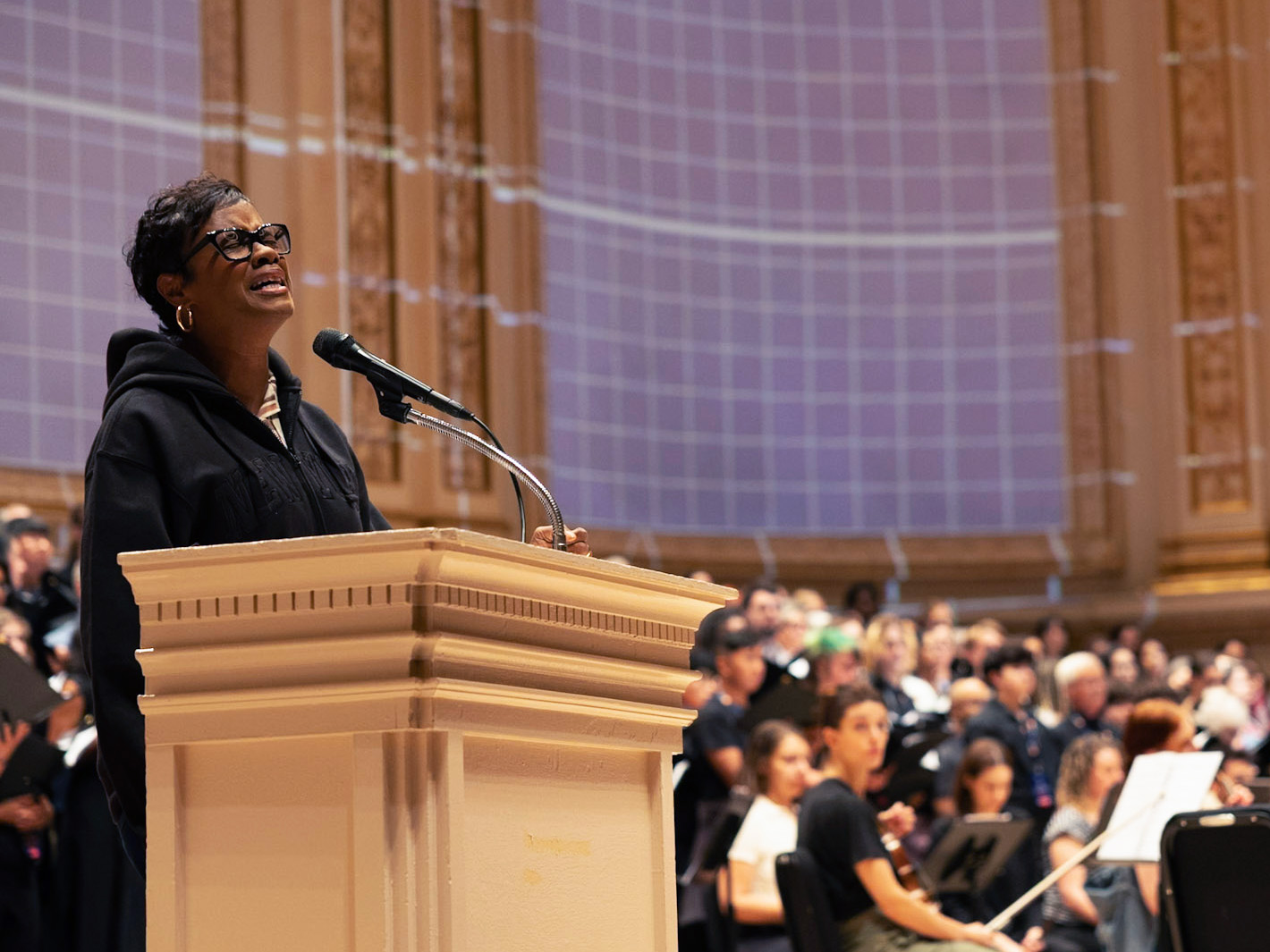
It is more common to hear sopranos and tenors have solos than it is to hear a solo from an alto or bass. Powell herself is a soprano.
“To see her utilize the low alto range in that way, like, off the dome — it wasn't even written — she just pulled it up from here?” Dorestin said, excitedly pointing to her own head. “Insane.”
During the final rehearsal of the final movement, unbeknownst to the students, Powell, still recovering from her stroke, entered the solo as well, transforming Dorestin and Trainor’s duet into a trio of unique yet powerful voices.
Dishny said this was “so motivating and really encouraged us to sing from our hearts, as she so beautifully did.”
As a veteran choral singer, I’ve performed in many great venues, but singing in Carnegie Hall felt like I was crossing off a bucket list item. No other experience has felt this prestigious. There were even times during the performance where I’d just subtly gaze in many different spots of the hall taking it in, as simply being in that space was truly a once-in-a-lifetime gift to us.
— Michael Dunn, BA in Political Science '27
During the actual performance, friends, family members, UC Davis alumni and Carnegie Hall visitors filled rows of the auditorium’s red velvet seats — many were moved to tears. There were two standing ovations.
“For me, as a conductor, this was probably one of the best, if not the best, performance I've had of my conducting career and I know the audience members were moved,” Dosman said.
Powell’s family was in the audience as well. Dosman said, “We all had a good cry backstage after that concert.”

UC Davis choirs makes history with Carnegie Hall debut
For the students who performed at Carnegie Hall, the event has become a highlight of their college career, a bonding experience they will never forget and a point of pride that they will carry with them forever.
“This is a historic event not just the music department but for the institution itself,” Dosman said. “I think that this will be something that will last in the memories of every single student.”
Dosman imagines them coming back for alumni events, saying: “Remember when we did Carnegie? With Rosephanye Powell, on stage!”
“I definitely feel very bittersweet with the trip being over as it was just so beautiful, but I am also just feeling so incredibly grateful for getting the opportunity to attend such a life changing experience with such an amazing and kind group of people,” Dishny said. “It has inspired me to try out new things and not allow obstacles to stop me from finding ways to pursue what I love.”
YOU MAY ALSO LIKE THESE STORIES

How to Be American
The ways of being American since then have been as various as everyone who has built a life here. Learn about the legal and cultural definitions of what it means to be American in the year the nation celebrates its 250th birthday.

Bad Bunny’s Code-Switching Helps Bilingual Students Feel Seen
The Spanish language is having a "historical moment of visibility" in the U.S. this year thanks to Puerto Rican musician Bad Bunny. The worldwide superstar's pride in his culture and use of language validates an experience that many bilingual Spanish speakers, including at UC Davis, relate to. Professors and students in the College of Letters and Science recently weighed in on the current cultural moment.