History graduate students at UC Davis are investigating past discrimination against the Black community in Sacramento during the 1950s and beyond. With direction from Professor Gregory Downs, and in partnership with the city of Sacramento and the Greater Sacramento Urban League, they seek to answer the question: What could reparations look like?
After completing his Ph.D. at the University of Chicago, UC Davis history professor Andrés Reséndez returned to Mexico, where he worked in everything from politics to historical consulting for soap operas. Learn about his current research on early European exploration and colonization of the Americas.
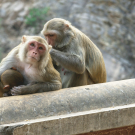
The brains of nonhuman primates respond to gentle, pleasurable touch in the same way as humans, even without awareness, researchers at the California National Primate Research Center have found. A new study poses fascinating questions about the role of consciousness in pleasurable touch, as well as age-related changes in the brain’s processing of touch.
In his new book “One from the Many: The Global Economy Since 1850,” Professor of Economics Christopher Meissner details the economic history of the global economy, grounding the idea of globalization in the technologies that have made it possible.
New research finds that for the past 150 years, immigrants in the United States have had lower incarceration rates than the U.S.-born, and since the 1960s that gap has significantly grown.
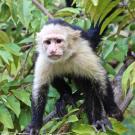
For the last six years, graduate student Meredith Carlson has studied the ongoing development of stone tool use in white-faced capuchins on the islands of Coiba and Jicarón, both located within Panama's Coiba National Park.
A project recently funded with a $2.2 million grant from the John Templeton Foundation is studying discovery and innovation across multidisciplinary teams of scientists working to understand various facets of agency and purpose across all forms of life.
A UC Davis research team in the Department of Communication is studying how children learn in a virtual reality environment. They recently opened this research to public participation at the Museum of Science and Curiosity, or MOSAC, in Sacramento, where undergraduate research assistants played a key role in making this research possible.
Psychologist and neuroscientist Charan Ranganath’s bestselling new book, "Why We Remember," combines the latest research from his field with his own personal experiences to share how memory actually works and the role it plays in our daily lives.
A new study in history is the first full-length academic article to describe the life of a once-influential veterinarian who has been overlooked first because of prejudice in the Cape Colony region and the subsequent apartheid that divided the nation of South Africa between white and non-white people.