




Food is essential to human existence both from a nutritional standpoint and in how we gather, celebrate, share, starve or thrive. Whether it originates from the soil or from a lab, how we think about our food can be seen in literature, art and culture throughout history. In the U.S., we are in an ongoing debate around which foods are healthy as we also navigate issues of transparency, ownership and access.
Welcome to Books of the Month, where once a month, L&S staff select works from our Bookshelf of authors within the College of Letters and Science at UC Davis. This month, as we head into the winter holiday season, let’s consider how we think about and interact with food. Our scholars are here to help.
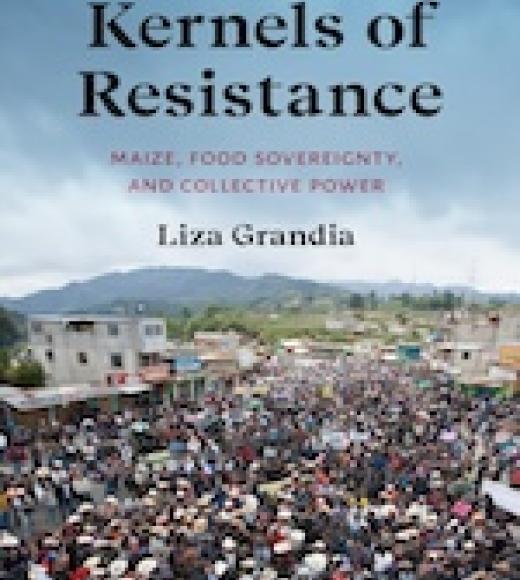
Kernels of Resistance
Liza Grandia (Department of Native American Studies)
In Kernels of Resistance: Maize, Food Sovereignty, and Collective Power (University of Washington Press, 2024), Professor Liza Grandia chronicles how diverse coalitions in Mexico and Guatemala have defended their sacred maize against corporate threats to privatize it. Rather than just "voting with their forks" like the consumer-driven U.S. food movement, Mesoamerican farmers and their allies have voted with their feet through direct action.

Real Food, Real Facts
Charlotte Biltekoff (Department of American Studies; Department of Food Science and Technology)
In Real Food, Real Facts: Processed Food and the Politics of Knowledge (University of California Press, 2024), Professor Charlotte Biltekoff explains how good food became “real” in the beginning of the 21st century and how the food industry has responded to increasingly negative public views of processed food with science-based education and information campaigns designed to “correct” what they see as public misperceptions.

A Thirst for Wine and War
Adam Zientek (History Department)
Beginning in the fall of 1914, every French soldier on the Western Front received a daily ration of wine from the army. In A Thirst for Wine and War: The Intoxication of French Soldiers on the Western Front (McGill-Queen's University Press, 2024), Associate Professor Adam Zientek explores the French army’s emotional and behavioral conditioning of soldiers through the distribution of a mind-altering drug that was later hailed as one of the army’s “fathers of victory.”

Feasting and Fasting in Opera
Pierpaolo Polzonetti (Department of Music)
In Feasting and Fasting in Opera: From Renaissance Banquets to the Callas Diet (The University of Chicago Press, 2021), Professor Pierpaolo Polzonetti explores how convivial culture shaped the birth of opera and opera-going rituals until the mid-19th century, when eating and drinking at the opera house were still common. Through analyses of convivial scenes in operas, the book also shows how the consumption of food and drink, and sharing or the refusal to do so, define characters’ identity and relationships.

Digging the Past: How and Why to Imagine Seventeenth-Century Agriculture
Frances Dolan (Department of English)
In Digging the Past: How and Why to Imagine Seventeenth-Century Agriculture (University of Pennsylvania Press, August 2020), by Distinguished Professor of English, emerita, Frances Dolan, examines histories of food and work, science, and reading and writing practices to offer case studies of projects heralded as agricultural innovations in the 17th century and today, such as composting and soil amendment, local food, natural wine and hedgerows.

Food and Literature
Frances Dolan, Parama Roy and Sandra Gilbert (Department of English)
Dolan, Professor of English Parama Roy and the now late-Sandra Gilbert, Distinguished Professor Emerita of English, each contributed to Food and Literature (Cambridge University Press, June 2018). The text examines food as subject, form, landscape, polemic and aesthetic statement in literature. It was the first volume to offer an overview of literary food studies and reflect on its origins, developments and applications.
YOU MAY ALSO LIKE THESE STORIES

Umbria Jazz Feast: Where Global Sounds Meet Italian Streets
In his newly released documentary film, Umbria Jazz Feast, UC Davis Professor of Music Pierpaolo Polzonetti investigates the perceptions and identities of jazz as it intersects with the cuisine, art, and culture of locals and visitors in Perugia, a medieval town in central Italy. A musicologist specializing in music and food, Polzonetti focused on how the festival enabled a synesthetic experience; that is, one in which different senses are simultaneously engaged.

Reimagining the Past Through Food Justice
With flavor and flair, a community of academics, chefs and food justice advocates are sparking conversation at UC Davis and beyond through the new seminar Thinking Food at the Intersections: Justice and Critical Food Studies. The seminar series is supported by a $225,000 grant from the Andrew W. Mellon Foundation received earlier this year.