



Letters and Science Scholars Contextualize State Violence


Welcome to Books of the Month, where once a month, L&S staff select works from our Bookshelf of authors within the College of Letters and Science at UC Davis. This month, as protests and political divides continue to disrupt lives across the U.S., we’ve selected books that grapple with these issues, telling stories of both survival and resistance.
Our scholars document and analyze some of the nation’s biggest societal upheavals, putting history – even recent history – into context.

Visuality of Violence
Ofelia Ortiz Cuevas (Department of Chicana/Chicano Studies)
In Visuality of Violence: Witnessing the Policing of Race (Temple University Press, 2025), Ofelia Ortiz Cuevas unpacks the way visual documentations and depictions of the practice of racial violence are used in imperialism, capitalism and neoliberalism in the U.S. Ortiz Cuevas traces the continuity of racial value through the shifting narratives of race by examining the long-running TV series, COPS and the museum exhibition, Without Sanctuary, which features photographs of lynching. These case studies provide an innovative holistic mapping of the policing and incarceration of Black and Brown people.

American Purgatory
Benjamin Weber (Department of African and African American Studies)
In American Purgatory: Prison Imperialism and the Rise of Mass Incarceration (New Press, 2023), Benjamin Weber tells the story of American incarceration, from its roots in racial slavery and colonialism to the present day, through the stories of the people who built resistance and freedom movements from within its confines. In the book, stories of survival and resistance take many forms. These stories show how criminal law and imprisonment have been used as tools to control and subdue groups who stand in political opposition.

Freedom Without Justice
Chol Soo Lee, Edited by Richard S. Kim (Department of Asian American Studies)
Freedom without Justice: The Prison Memoir of Chol Soo Lee (University of Hawaii Press, 2017) is the compelling story of Chol Soo Lee’s wrongful imprisonment and his years of survival in prison, while political activists fought to win his freedom. His saga took place against a backdrop of great historical change in Asian American communities following the passage of the 1965 Immigration Act.
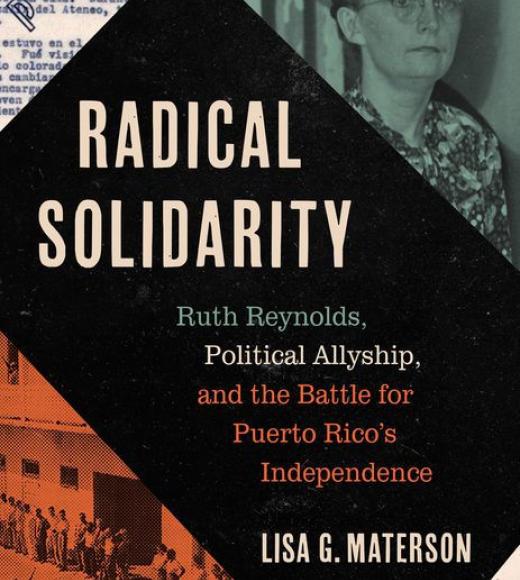
Radical Solidarity
Lisa G. Materson (Department of History)
How does a middle-class white woman from South Dakota end up becoming a political prisoner in 1950’s Puerto Rico convicted of trying to overthrow the colonial government?In Radical Solidarity: Ruth Reynolds, Politcal Allyship and the Battle for Puerto Rico's Independence (The University of North Carolina Press, 2024), Lisa G. Materson unravels the puzzle of how Ruth Reynolds, an American adherent of Gandhian nonviolence, became a close ally of Puerto Rican revolutionaries resisting US control of Puerto Rico.

Explosivity
Javier Arbona-Homar (Department of American Studies and Department of Design)
Offering a novel approach to contemporary landscape studies, Explosivity: Following What Remains (University of Minnesota Press, 2025) unearths the hidden legacies of violence that have shaped the physical and cultural environment of the San Francisco Bay area. Javier Arbona-Homar analyzes a series of explosions that took place between 1866 and 2011 to call attention to the scattered remnants of militarism and racialized capitalism embedded in the region’s geography.

American Carnage
Sasha Abramsky (University Writing Center)
In American Carnage: How Trump, Musk, and DOGE Butchered the US Government (OR Books, 2026), journalist Sasha Abramsky follows 11 federal workers, in eight government agencies, from the time they were told they were fired in the early weeks of Donald Trump’s second presidential administration through to the summer of 2025. With Trump having empowered the world’s richest man, Elon Musk, and his Department of Government Efficiency, to make dramatic cuts to many of the country’s most important agencies, what unfolded in these months was a cascading tragedy of historic proportions.

After Appomattox: Military Occupation and the Ends of War
Gregory Downs (Department of History)
In After Appomattox: Military Occupation and the Ends of War (Harvard University Press, 2019) Gregory Downs argues that the war did not end with Confederate capitulation in 1865. Instead, a second phase commenced which lasted until 1871. Using its war powers, the U.S. Army oversaw an ambitious occupation, stationing tens of thousands of troops in hundreds of outposts across the defeated South.
This groundbreaking study of the post-surrender occupation makes clear that its purpose was to crush slavery and to create meaningful civil and political rights for freed people in the face of rebels’ bold resistance.
YOU MAY ALSO LIKE THESE STORIES

How Auctions Shaped Buying, Value and What Can Be Owned in Early America
Historian Ellen Hartigan-O'Connor’s recent book details how auctions created the foundations for our modern economic system as it made and unmade people and communities by collectively setting a price on anything for sale.

Research Suggests Nationwide Racial Disparities in Media Reporting on Gun Violence
New research finds nationwide, race-based disparities in mass shooting media reports.