




There’s something alluring about the night sky. Turn an eye towards it and you can’t help but feel an invitation to gaze upwards and wonder.
How did all of this — the universe — arise?
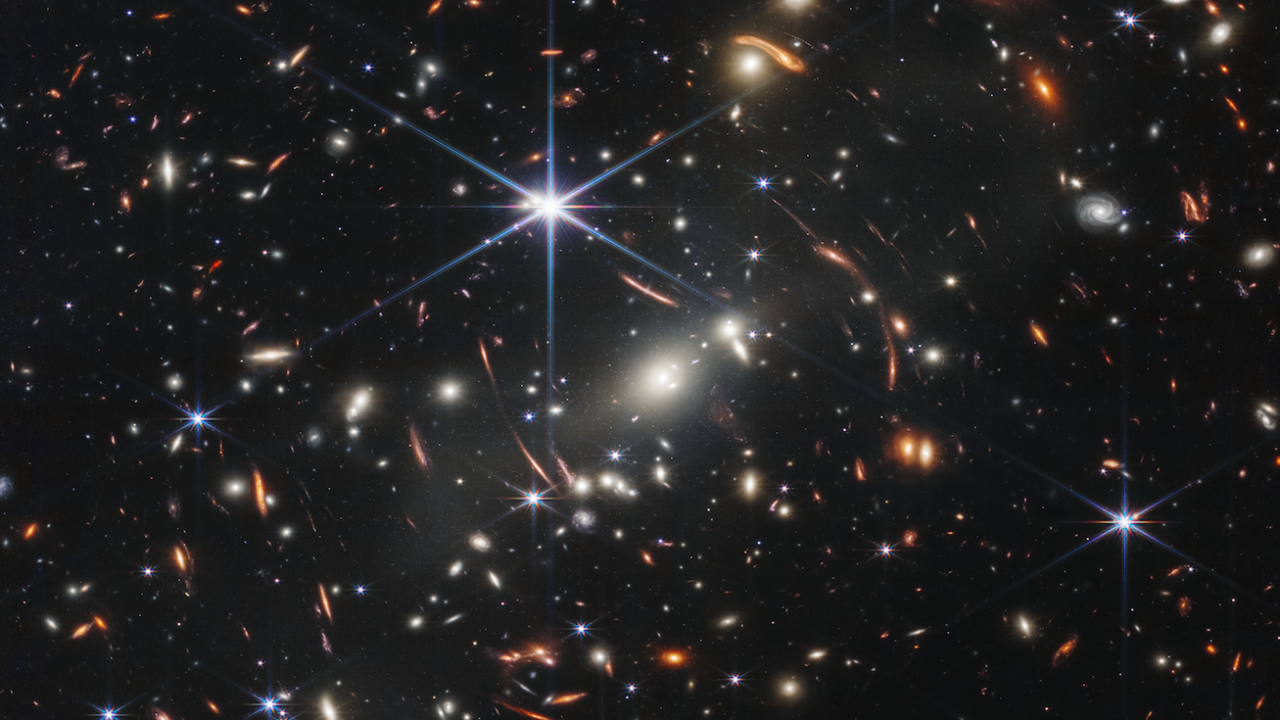
To glimpse the earliest days of the cosmos, astronomers like UC Davis Associate Professor Tucker Jones rely not only on the magnification of telescopes, but also on powerful natural magnification from our cosmic neighbors in the form of gravitational lenses. Gravitational lenses basically magnify the size and brightness of distant objects and can even provide astronomers with multiple images of those objects.

“The issue is these lensing configurations are very rare, because what you need is a large concentration of mass — which means a big galaxy or cluster of galaxies — with another galaxy, or object of interest, directly behind it,” said Jones, who studies galaxy formation in the Department of Physics and Astronomy at the College of Letters and Science at UC Davis.
How does a gravitational lens work?
Gravitational lenses work like regular lenses. Gravity from a massive celestial object causes light to bend around it, just how light bends when passing through a magnifying glass.
“Photons — particles of light — will appear to change their path when they pass near a massive object, which is not very intuitive because light doesn’t have any mass,” Jones said. “We think of gravity as normally acting on objects with mass, but Einstein’s theory of relativity shows very clearly that gravity is effectively a distortion in spacetime. Photons travel through that distorted spacetime and their paths appear to bend.”
As a result, the celestial objects beyond the gravitational lens appear magnified.
“These are very valuable systems, especially ones that are really highly magnified,” Jones said. “We find many objects that are magnified maybe 10 times, but in some more extreme cases, they might be magnified 100 times by very massive lenses such as galaxy clusters.”
How do astronomers use gravitational lenses to study the universe?
In the past, identifying gravitational lenses in the night sky was an incredibly cumbersome task. It required sharp eyes, time and the drive to sift through tens of thousands of images gathered by telescopes.
“Something like one in every 10,000 of those galaxies would have a galaxy behind it being strongly lensed,” Jones said. “It’s the problem of looking for needles in a haystack.”
But within the last five years, researchers like Jones, in collaboration with computer scientists, have started employing machine learning algorithms to identify gravitational lens candidates in the sky.
“We know what a lens should look like and we can train a neural network on a computer to learn to recognize them,” Jones said. “Then we can say, ‘Okay, here’s 20 square degrees of the sky, or 20,000 square degrees of the sky, go nuts. Tell us what you think are lenses.’ And the neural network tells us what it thinks are lenses.”
The technological development has revolutionized the search for gravitational lenses. Within the past few years, a machine learning algorithm identified nearly 5,000 potential gravitational lenses.
An international team of astronomers, including Jones and former UC Davis graduate student Keerthi Vasan, later investigated 77 of those lens candidates, confirming that 68 of them were strong gravitational lenses.
While gravitational lens-identifying, machine learning algorithms are trained on existing galaxy and gravitational lens imagery, simulated gravitational lenses also play a key role in the dataset.
According to Jones, the number of known gravitational lenses is on the order of 1,000, which is nowhere near enough to train a machine learning algorithm. Such an algorithm should be trained on the order of hundreds of thousands of images. To make up for the lack of imagery, Jones and his team simulated their own images to use in the dataset.
But identifying gravitational lenses is just the start.
What gravitational lenses reveal about galaxy formation
While identifying gravitational lenses is part of Jones’ research interests, identification is a springboard for other research questions. By harnessing the power of gravitational lenses, Jones can view distant galaxies at a greater spatial resolution, giving him a better view into their internal structure and composition.
“Here’s a galaxy that’s far away,” Jones said. “Does it have a disc of stars and gas? Does it have regular angular momentum? Is it chaotic? Is it growing ‘hierarchically’ with many smaller objects slamming together or is it growing through buildup of stars in a disc?”
All that and more can be gleaned with the help of gravitational lenses. And exploring such questions will help humanity learn more about how galaxies form over cosmic time into the beautiful spiral structures seen today, such as our own Milky Way.
“We’re getting to the point where we’ve confirmed these candidates,” Jones said. “Now, we’re following up to address the really interesting science.”
YOU MAY ALSO LIKE THESE STORIES
Astronomers Find Mystery Dark Object in Distant Universe
Using a global network of telescopes, astronomers have detected the lowest-mass dark object yet found in the universe. The work is described in two papers published Oct. 9 in Nature Astronomy and Monthly Notices of the Royal Astronomical Society.
Sifting Through the Cosmic Noise
Tony Tyson, a Distinguished Research Professor in the Department of Physics and Astronomy, recounts the origin of the Rubin Observatory and his decades-long journey to make the facility a reality.