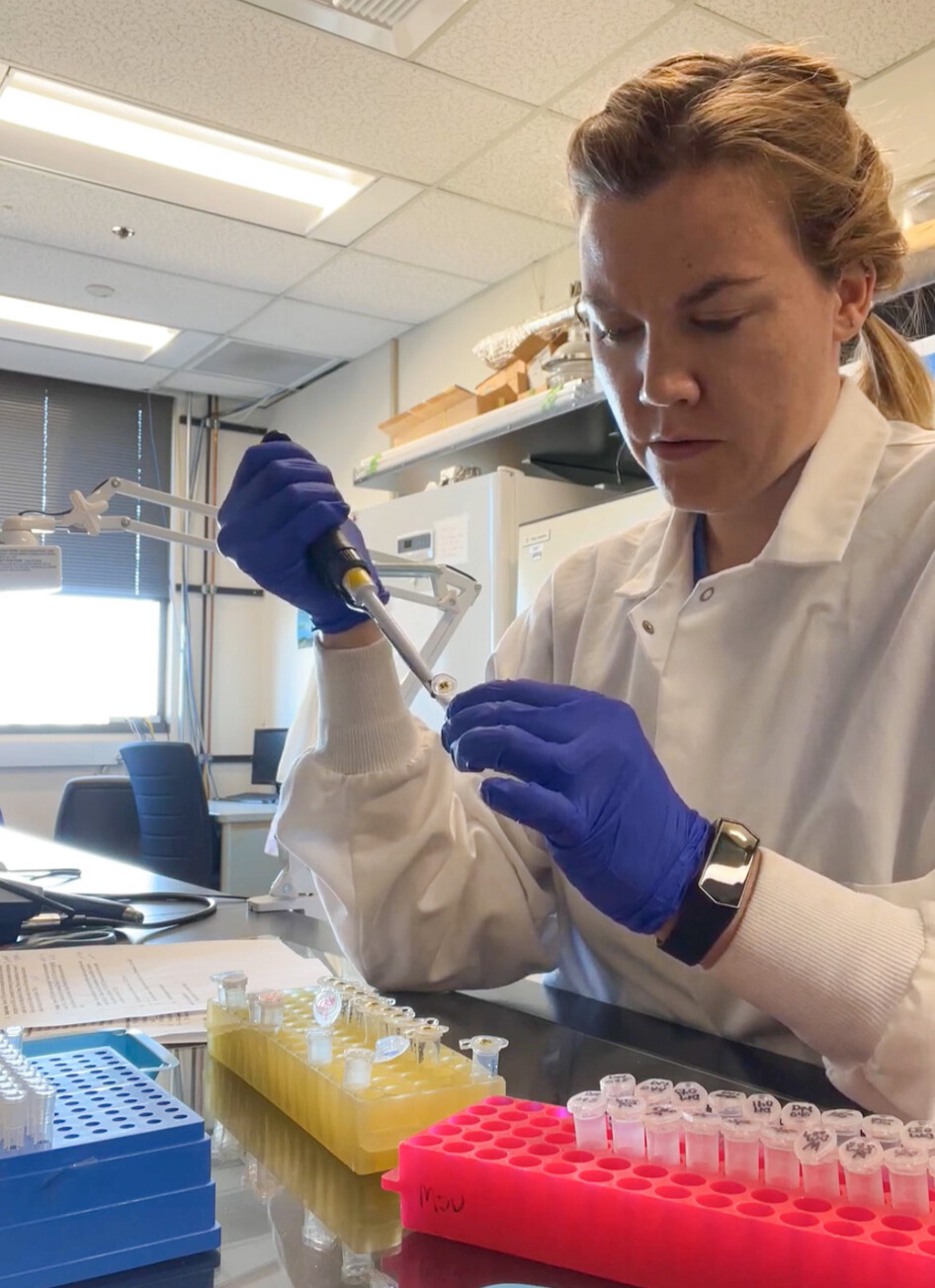
A bioarcheologist interested in the diets of people long past, UC Davis Ph.D. candidate Diana Malarchik, Department of Anthropology, analyzes the geochemical signatures of teeth to better understand major shifts in breastfeeding and maternal behavior in the past. (Image by huertacs from Pixabay)
What Do Your Teeth Reveal About Your Diet?
UC Davis Bioarcheologist Explores Questions of Motherhood and Equality Both Past and Present
by Greg Watry
Diana Malarchik walked over to a locked door inside a lab on the third floor of Wickson Hall.
“I’m just going to do this carefully,” she said, punching in the door’s alarm and special access codes. “One time, I set off the alarm and I had to call the campus cops and say, ‘Whoops, me again.’ … OK, I’ve disarmed it.”
“This is where we keep all our teaching collections, so these are our zooarchaeological remains,” she said, pointing to cabinets and drawers filled with skeletal remains. “Here’s a deer and over there, we have our osteological collection, so each gray box is an individual that we use to teach. Oh, and here, we have standing skeletons.”
The informal tour ended at a lone cabinet.
“And this is where I keep my guys,” she said.
Malarchik pulled out plastic bags from the cabinet’s drawers. Inside the bags were human teeth.
“I just went to collect more samples over spring break,” she said. “These are samples I still need to drill.”
Malarchik is a bioarcheologist interested in the diets of people long past. For part of her dissertation, she’s analyzing the geochemical signatures of hundreds of teeth from people who lived in the San Francisco area during the 1800s.
You see, teeth retain the chemical signatures at the time when they were grown, starting at birth and ending in your late teens. And my work highlights major shifts in breastfeeding and maternal behavior in the past. — Diana Malarchik
Your life in a tooth
Teeth chronicle the past. Much like trees, they grow in rings from the top down. These rings, or growth marks, act like a record of development.
“Based on this anatomy, I can sample these growth rings and get nitrogen signatures and create a dietary timeline,” Malarchik said. “Looking at a person’s dietary timeline, I focus on the first few years of a person’s life — when they were breastfed.”
The importance of breastfeeding on early development can’t be overstated. The fats, proteins and antibodies, among other nutrients, present in breast milk provide a baby with immune support and the necessary gut flora for healthy digestion.
“There’s also studies that show that the healthier you are as a kid, the healthier you are as an adult,” Malarchik added.
Through geochemical analyses of a tooth, Malarchik can discern if and for just how long an individual was breastfed. In her analysis of teeth from people living in 1800s San Francisco, she’s noticed three patterns:
Gradual weaning: An individual is gradually weaned off breast milk over a few years.
Shortened weaning: An individual shows signatures of roughly six months of breastfeeding.
Absent signature: An individual shows no signature of breastfeeding.
This is a significant discovery, as it means these people survived childhood with little or no support from breast milk. Before the 20th century, breastfeeding was the only way a baby could get safe food and immune support. Without this, mothers would’ve turned to early versions of formula, which was just soaking bread in water. And to make it worse, the water was most likely full of harmful bacteria. — Diana Malarchik
Through geochemical analyses of a tooth, Malarchik can discern if and for just how long an individual was breastfed.
But another pattern also emerged. Malarchik found that shortened and absent weaning signatures were more prevalent in those buried in public cemeteries, where no payment was required, versus those buried in private cemeteries, where plots were purchased by families.
“Meaning that children from lower socioeconomic statuses were the most affected,” she said, noting that lower class new mothers most likely had to return to work much more quickly after giving birth. “If you were able to breastfeed, especially in a time pre-antibiotics, pre-vaccines, you’re going to be healthier as a child and then you’re going to be healthier as an adult.”
Giving voice to those lost to history
According to Malarchik, while San Francisco doesn’t currently have any operational cemeteries, that wasn’t the case from 1850 to the 1930s. During that time, six major cemeteries existed, with major sites occupying what is now the Richmond District and the University of San Francisco campus. As a result of the New Deal, many cemeteries were moved to the nearby town of Colma.
“But they didn’t get everyone,” Malarchik said. “Sometimes they just missed a grave but often they didn’t really put a lot of effort into moving a public, or free, graves. Even in death, poor people were being ignored and mistreated. There are even some estimates that more than 10,000 public graves were left in City Cemetery, where Baker Beach is now.”
This has led to historic graves being uncovered in San Francisco throughout modernity. This is how Malarchik happens upon the people she studies.
When a grave is unearthed during construction activities, cultural resource management companies and professional archeologists are called in to investigate. Malarchik is one of the people who then does lab work to learn as much as possible about the unearthed before they are reburied.
It is really important to me that these people, ones forgotten to time, get a second chance to tell their story. And if I’m the only person who can ‘hear it’ by looking at their isotopes, then I am going to make sure they are heard. — Diana Malarchik
According to Malarchik, this inequity in childrearing between upper and lower classes — something she sees in the isotopes she analyzes — persists to this day.
Malarchik is analyzing the teeth from people who lived in the San Francisco area during the 1800s.
Problems of the past, problems of today
Malarchik’s research is deeply personal. A new mother herself, she knows intimately the challenges of juggling motherhood and professional life.
“In the U.S., only 13 states have some sort of paid family leave. I work in California, where I got paid time off in a department that is so supportive, and it’s still so difficult” she said. “It’s so hard for me to imagine women who go back to work and don’t have that support and then on top of that, their kids are going to be sicker.”
While the advent of infant formula has helped supplement infant nutrition, concerns about quality abound.
“Consumer Reports just came out with a study where they looked at 41 formulas, many of which contain lead and arsenic,” Malarchik said.
Malarchik hopes her research will help bring awareness to issues concerning the societal challenges mothers face.
Mothers today are still being forced to make many of the same decisions that their great, great, great grandmothers made in the 1800s. Unless we learn from the past, we will be forced to relive it. — Diana Malarchik