



Is the United States Finally Able to Implement W.E.B. Dubois' Vision?


Democracy means equal representation. A fair democracy achieves a common good by supporting all voices, regardless of race, gender or nationality.
These were the ideals argued by civil rights activist W.E.B. Du Bois back in the 19th and 20th century. Du Bois lived in an America that restricted who could participate in democracy.
“Du Bois gives us a picture of how to resist that status quo through a vision of progress oriented around inclusion,” said Elvira Basevich, an assistant professor of philosophy in the College of Letters and Science at UC Davis.
Basevich is an expert in political and Africana philosophy. She is currently researching Du Bois’ theories on democracy. His ideas reveal how and why we need to update our old democratic system to solve the problems modern workers face today.
W.E.B. Du Bois’ vision for a democracy after Reconstruction
Basevich explained that Du Bois’ understanding of democracy was shaped by his experiences during the Reconstruction Era. After the Civil War, the U.S. attempted to update its legal, social and political systems to include millions of freed Black Americans.
“There can be no perfect democracy curtailed by color, race, or poverty. But with all we accomplish all, even peace." — W.E.B. DuBois
During that time, Du Bois studied the impact of slavery on the personal lives and experiences of Black Americans. He was concerned that, after the abolishment of slavery, people believed racism was no longer a problem in America.
Du Bois set out to study democracy from the perspective of those who, due to their race, gender and nationality, the U.S. had blocked from voting.
“For him it's not just enough to appeal to moral, egalitarian ideals,” said Basevich. “You have to look at the way society has failed to live up to these ideas without giving them up.”
Du Bois thought anyone could make decisions serving the common good. He thought citizens needed to participate in democratic deliberation by discussing and debating different political stances and philosophies. In doing so, he believed people would make policies that benefited everyone equally. Democracy, he believed, assumes everyone has a strong enough moral compass to make the right choices.
Du Bois focused particularly on how labor could lead us to discover new rights that achieve a common good.
Why America’s democracy is rooted in outdated ideals
According to Basevich, our current democracy is rooted in outdated ideals which no longer apply to today’s workers, creating unique challenges for the modern-day United States. The country was founded as an agrarian democracy valuing independent farmers more than paid workers, the law catering to the former’s needs. However, nowadays, a vast majority of people are paid workers.
There can be no perfect democracy curtailed by color, race, or poverty. But with all we accomplish all, even peace."
— W.E.B. Du Bois
Basevich said this shift creates an exciting philosophical puzzle based on Du Bois’ ideas. He argued farmers could only achieve equality if they had complete control over their work. He explored how, during Reconstruction, there was a push for Black freedmen to control their own land and farming equipment so they would not have to depend on white overseers.
“He ends up having a pretty pro-laborer vision of democracy,” Basevich said. “Part of the philosophical challenge is identifying what workers need to have democratic control over their workplace.”
How W.E.B. Du Bois inspires a more inclusive democracy today
Although Du Bois’ ideas could help update our democracy to benefit workers, we do not have the tools we need to make these changes. One of these tools, Basevich said, is a safe environment to discuss politics.
“We have these crazy debates with talking heads on TV, but what they’re talking about is not necessarily representative of actual experiences and troubles,” said Basevich. “Part of the democratic challenge of our time is finding space to have those conversations.”
College campuses used to be a place where students not only developed their occupational skills but also engaged in open-ended academic growth. But now, students mainly attend college to launch their careers, focusing less on their intellectual development, and more on getting a job. Meanwhile, when they graduate and enter the workplace, they must leave politics at home.
Basevich said we need informal, public spaces to hash out what we think about different stances. In those spaces, we can learn what our community thinks and what we all have in common.
Though some conversations are hard, even uncomfortable, she said, talking about these subjects opens our minds to new perspectives, encouraging equal democracy.
“Du Bois thought of democracy as an invitation for everybody,” said Basevich. “He doesn’t want to give up that bigger ideal.”
YOU MAY ALSO LIKE THESE STORIES
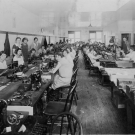
New Book Reveals Arab American Textile Workers' Impact on Strike History
In a new book, historian Stacy Fahrenthold unravels the history of Lebanese, Syrian and Palestinian immigrants’ activism in the global textile industry and labor strikes. Her book reveals how women garment workers, child laborers and union activists struggled against white and even Arab American bosses, as well as why their impact has gone ignored.

Fighting for a Fulfilling Life
As historian Traci Parker writes a new biography, she is learning just how much Coretta Scott King contributed to her husband’s ideas and actions, and how his story is also very much her own.