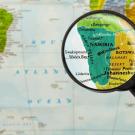
In a study appearing in Science Advances, researchers analyzed genetic samples from individuals who self-identified as South African Colored, a term denoting mixed ancestry. The researchers found that modern populations of this group in the Western and Northern Cape provinces retain majority Khoe-San genetic ancestry, exceeding 48%.
A genomic analysis of over 1,200 people from across South Africa reveals how colonial-era European, Indigenous Khoe-San peoples, and enslaved people contributed to the modern-day gene pool in South Africa.
Two chemists studying debilitating diseases and a population geneticist untangling early human evolution are the recipients of this year’s Incentives for Large Grant Awards from the College of Letters and Science at UC Davis. The Incentives for Large Grant Awards program provides faculty with up to $80,000 in support over two years to pursue large grants over $1 million.
To democratize the precision medicine space, the Henn Lab is spearheading two projects funded by the National Institutes of Health for nearly $812,000.
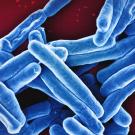
In a study appearing in PLOS Global Public Health, UC Davis researchers investigated the epidemiological risk factors, outside of HIV, associated with TB in South Africa’s Northern Cape Province.
When it comes to the architecture of the human genome, it’s only a matter of time before harmful genes arise in a population. These mutations accumulate in the gene pool, primarily affected by a population’s size and practices like marrying within a small community. New research published in the Proceedings of the National Academy of Sciences (PNAS) journal provides rare direct evidence showing that increased homozygosity leads to negative effects on fertility in a human population.