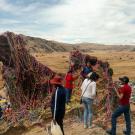
Psychologists, cultural anthropologists, and evolutionary biologists weigh in on these questions in this volume, often using specific cultural contexts as case studies to elucidate both the particularities and common patterns in the ways essentialism does, or does not, work in the real world.
An author blending fact and fiction in her second novel, an anthropologist studying the origins of rituals and pilgrimages, and a mathematician investigating the complexity of large datasets have been named the 2026 Dean’s Faculty Fellows for the College of Letters and Science at UC Davis.
How do pilgrimages get established? How do people become convinced to try something new? Using a theoretical game model, University of California, Davis, anthropologists suggest that lucky outcomes can sometimes give rise to the perception that a new site cures, blesses, grants miracles or otherwise produces great outcomes in pilgrims’ lives.
How do pilgrimages and rituals arise? How do people become convinced to try something new? What makes a place so special that it persists through time, drawing people to it again and again? UC Davis anthropologists Cristina Moya and Nicolas Restrepo Ochoa are answering these questions at the ground floor.