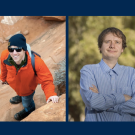
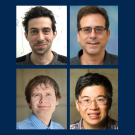
Two UC Davis professors were recently named as winners of 2024 Frontiers of Science Awards from the International Congress of Basic Science. Professor Adam Jacob, Department of Mathematics, received the award in mathematics and Professor Jaroslav Trnka, Department of Physics and Astronomy, received the award in theoretical physics.
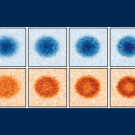
Historically, the Fermi-Hubbard model's theoretical and experimental applications have been limited to atoms with electrons that exist in two possible states. In new research, UC Davis physicists and an international research team expanded the Fermi-Hubbard model, allowing for a more detailed exploration of materials and their properties.
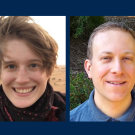
A UC Davis theoretical physicist studying the quantum nature of matter and a mathematician investigating the complexity of large datasets are the recipients of grants totaling more than $1.2 million from the National Science Foundation’s Faculty Early Career Development Program (CAREER).
Three faculty members from the College of Letters and Science are among UC Davis' newest class of Chancellor's Fellows, a title given to early career academics doing exemplary work. The Chancellor’s Fellows program was created in 2000, and this year’s class brings the total number of recipients to an even 200. Recipients carry the title for five years and are awarded $25,000 in unrestricted philanthropic support for research or other scholarly work.
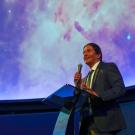
This week, Manuel Calderón de la Barca Sánchez returned to his alma mater in Mexico to host screenings of ‘Secrets of the Universe,’ an IMAX film that explores the formation of the universe through the eyes of Aggie researchers. Calderón de la Barca Sánchez, a UC Davis physics professor, hopes the film will inspire students to pursue STEM education and careers.
A mathematician, a linguist, a chemist and a physicist are among this year’s cohort to receive Incentives for Large Grant Awards from the College of Letters and Science at UC Davis. The Incentives for Large Grant Awards program provides faculty with up to $80,000 in support over two years to pursue large grants over $1 million.
In two new papers appearing in Physical Review Research, UC Davis and Los Alamos National Laboratory researchers introduce a new model to explain the phenomenon of decoherence, when a system’s behavior shifts from being explainable by quantum mechanics to being explainable by classical mechanics. The new model divorces the arrow of time from the go-to theoretical tool for understanding decoherence.