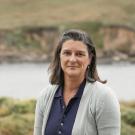
Professor Tessa Hill has been named associate dean of research and graduate education in the College of Letters and Science at UC Davis. In the position, Hill will facilitate and support cross-departmental and cross-college research initiatives, oversee contracts and grants, and develop mentorship programs to cultivate research expertise and collaboration among faculty. In addition, she’ll oversee graduate students and studies in the college.
While not nearly as prevalent or long-lived in the atmosphere as carbon dioxide, increasing methane emissions are a problem for the environment. Responsible for about one-third of the Earth’s warming, methane is about 80 times more powerful in terms of global heating than carbon dioxide. Oceanographer Tessa Hill talks about what can be done to mitigate this.
Every year, the Bodega Marine Laboratory hosts summer sessions for undergraduate students interested in coastal systems and marine science. During the roughly five-week program, students take classes in topics like coastal oceanography, marine environmental issues and biological oceanography. They conduct fieldwork and go on field trips to nearby sites like the Hog Island Oyster Company. Students can even live at the lab’s on-site dormitory during the session.
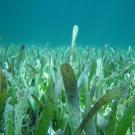
In this video, UC Davis marine scientist Elisabeth Sellinger explores the global importance of eelgrass, its role along the California coast, and how the Greater Farallones and Monterey Bay National Marine Sanctuaries help protect and restore these essential habitats.
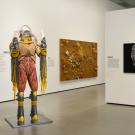
Walk through the "Breath(e)" exhibit with various scholars from different departments across the College of Letters and Science as they reflect on the art and how it connects to their own work and the world.
UC Davis Professor Tessa Hill spoke about the benefits that can come from fast action on methane with the hosts of We Don’t Have Time during this year’s Climate Week NYC, held Sept 21-28. She was joined by Fatima Denton, director of the United Nations University-Institute for Natural Resources in Africa.
Explore new interpretations of classic land ethics, multiple cases of climate action and land sovereignty and witness how past generations reacted to the changing climate. Scholars from across the College of Letters and Science provide insight into how human action and inaction has influenced the natural environment around us.
The Office of Public Scholarship and Engagement has unveiled its fifth class of Public Scholarship Faculty Fellows. Check out the L&S faculty members who made the list!
At the most recent Davis Science Café, Professor Tessa Hill, Department of Earth and Planetary Sciences, discussed the rapid changes occurring in the oceans due to human-induced climate change. But a potential solution may reside in the disappearing seagrass beds hugging the California coastline.
In the prologue for their book At Every Depth: Our Growing Knowledge of the Changing Oceans, UC Davis scientist Tessa Hill and writer Eric Simons open with an astute observation about humanity’s relationship with the ocean. While so much of the big blue is still a mystery to us, the beauty and life within it are being affected by our choices as a species. In some ways, the oceans are changing faster than we can study them.