




Welcome to Books of the Month, where once a month, L&S staff select works from our Bookshelf of authors within the College of Letters and Science at UC Davis. This month, we are exploring the depth and impact of climate change with a packed list of scholarly texts.
Explore new interpretations of classic land ethics, multiple cases of climate action and land sovereignty and witness how past generations reacted to the changing climate. Scholars from across the College of Letters and Science provide insight into how human action and inaction has influenced the natural environment around us.

At Every Depth: Our Growing Knowledge of the Changing Oceans
Tessa Hill (Earth and Planetary Sciences)
While so much of the ocean is still a mystery to us, the beauty and life within it are being affected by our choices as a species. At Every Depth: Our Growing Knowledge of the Changing Oceans by oceanographer Tessa Hill and writer Eric Simons chronicles those changes through the eyes of the community members closest to the shores. This book isn't a passive volume — it’s a call to action.

The Land is Our Community
Roberta L. Millstein (Department of Philosophy)
In a classic essay, published posthumously in A Sand County Almanac, conservationist Aldo Leopold advocated for an expansion of our ethical obligations beyond humanity to include what he termed the “land community” or the “biotic community” — communities of interdependent humans, nonhuman animals, plants, soils and waters. Using an approach grounded in environmental ethics and the history and philosophy of science, Professor Emerit Roberta L. Millstein reexamines Leopold’s land ethic in light of contemporary ecology. In this book, she provides new interpretations of the central concepts underlying the land ethic: interdependence, land community and land health.

Environmental Justice in a Moment of Danger
Julie Sze (Department of American Studies)
In Environmental Justice in a Moment of Danger, Professor Julie Sze examines a range of mobilizations and movements. From protests at Standing Rock to activism in Puerto Rico in the wake of Hurricane Maria, this book looks at dispossession, deregulation, privatization and inequality paired with cautiously hopeful stories of change.

California Changing: 50 Sites of Climate Change in Augmented Reality
Brett Snyder (Department of Design)
In California Changing: 50 Sites of Climate Change in Augmented Reality, Associate Professor Brett Snyder takes a small-scale approach to seeing the ways that climate vulnerability and resilience has changed and is changing the very places we reside. A cabin at risk of wildfire. A house at risk of erosion. A public walkway that is estimated to be underwater in 10 years time. This book is illustrated with 50 sites across California — an atlas of sorts — raising questions about how we live, what we value, and issues we might consider as we plan for the future.

The Evolution of Power: A New Understanding of the History of Life
Geerat Vermeij (Earth and Planetary Sciences)
Distinguished Professor Geerat Vermeij talks about findings he’s gleaned from his meticulous study of extinct creatures. This research has yielded broader insights about evolution, humanity, biology, economics and the role of power. The book extrapolates on the idea that “the history of life on Earth can be meaningfully and informatively interpreted as a history of power” with the human species representing the current apex. Vermeij defines power as “energy taken up or spent per unit of time.”

The Small Matter of Suing Chevron
Suzana Sawyer (Department of Anthropology)
In 2011, an Ecuadorian court issued the world’s largest environmental contamination liability: a $9.5 billion judgment against Chevron. Within years, a U.S. federal court and an international tribunal determined that the Ecuadorian judgment had been procured through fraud and was unenforceable. In The Small Matter of Suing Chevron, Professor Suzana Sawyer delves into this legal trilogy to explore how distinct legal truths were composed through chemical, scientific and legal technique — transforming a contamination claim into an environmental liability then a racketeering scheme and, ultimately, a breach of treaty.
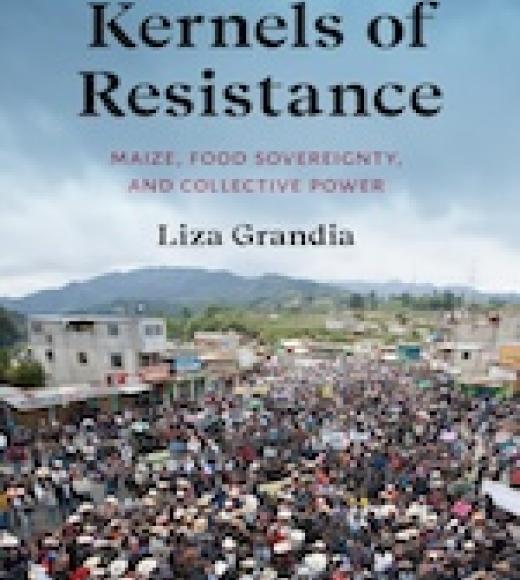
Kernels of Resistance: Maize, Food Sovereignty, and Collective Power
Liza Grandia (Department of Native American Studies)
In Kernels of Resistance: Maize, Food Sovereignty, and Collective Power, Professor Liza Grandia chronicles how diverse coalitions in Mexico and Guatemala have defended their sacred maize against corporate threats to privatize it. Rather than just "voting with their forks" like the consumer-driven US food movement, Mesoamerican farmers and their allies have voted with their feet through direct action. In a world of interconnected trade, their victories chart a path that other food movements might follow. They also show how everyday people can demand better regulatory protections for environmental health and forge more climate-resilient agricultural systems with native seed saving.

Upstream: Trust Lands and Power on the Feather River
Beth Rose Middleton Manning (Department of Native American Studies)
In Upstream: Trust Lands and Power on the Feather River, Professor Beth Rose Middleton Manning examines how native land allotments in California were taken over for various hydroelectric power projects, focusing on the Feather River, as well as Native American resistance to such projects.

Remainders: American Poetry at Nature's End
Margaret Ronda (Department of English)
In Remainders: American Poetry at Nature's End, Associate Professor Margaret Ronda takes readers through a literary history of post-war American poetry that reflects on new dimensions of ecological crisis. These poems portray various forms of remainders that convey the ecological consequences of global economic development.

Extraction Ecologies and the Literature of the Long Exhaustion
Elizabeth Miller (Department of English)
In Extraction Ecologies and the Literature of the Long Exhaustion, Professor Elizabeth Miller examines how literature created during the rise of large-scale mining in the British imperial world from 1830 to 1930 reflected and commented upon a world where humans became dependent on finite, nonrenewable resources.
YOU MAY ALSO LIKE THESE STORIES

Equations in the Sand
Mathematics permeates our lives. It’s there even when it escapes our comprehension. Anne Schilling discusses the predictive power of mathematics and her research on “Markov chains,” which are probability models that describe the sequence of events/states based on the past. It’s a concept that can be applied to a lot more than just your dresser drawer, including weather, voting procedures and quantum physics.

Nowcasting and the Kamchatka Earthquake
The July 29 earthquake on Russia's Kamchatka peninsula was among the most powerful recorded by modern instruments, setting off tsunami warnings around the Pacific rim. John Rundle, Distinguished Professor in the departments of Physics and Astronomy and of Earth and Planetary Sciences at UC Davis, had previously included the Kamchatka region in an analysis of earthquake risk published in 2018.