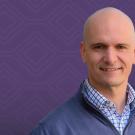
What does it take to climb more than 23,000 feet? UC Davis chemistry professor and mountaineer Davide Donadio spent a month in Tajikistan, summiting Ismoil Somoni Peak and Korzhenevskaya Peak in the Pamir
Mountains.
Dawn Sumner — a UC Davis geologist, planetary scientist and astrobiologist — is among the 53 scientists newly elected as fellows of the American Geophysical Union, or AGU, for outstanding achievements and contributions to earth and space science.
In an effort to share all the exciting and often mind-bending revelations about the universe with the public, UC Davis scientists Lloyd Knox and Markus Luty are bringing their combined knowledge and expertise on the road for a traveling conversation called Cosmic Connections.
In a new study, a research team used advanced geochemical dating and analysis techniques to reveal that some asteroids and meteorites, such as Ryugu and Ivuna, originate from celestial bodies that formed less than 2 million years after the beginning of the solar system. This coincides with a period when the solar system was forming its first generation of planetesimals, the building blocks of planets.
The Blavatnik Family Foundation and The New York Academy of Sciences today named 18 finalists for the 2026 Blavatnik National Awards for Young Scientists. The awards recognize scientific advances made by researchers in the United States across the following disciplines: life sciences, chemical sciences, and physical sciences & engineering.
UC Davis researchers are advancing RNA editing, a promising approach that could enable new therapies for genetic diseases without permanently altering DNA. The foundational science has shown great promise with the National Institutes of Health has invested millions of dollars in the research.
University of California, Davis, researchers have stripped down LSD to the base features responsible for its hallucinogenic and therapeutic effects. In a new study, the researchers whittled away at LSD’s core multi-ring structure and synthesized new, simplified versions of it to probe its functionality.
In a study appearing in Science Advances, researchers analyzed genetic samples from individuals who self-identified as South African Colored, a term denoting mixed ancestry. The researchers found that modern populations of this group in the Western and Northern Cape provinces retain majority Khoe-San genetic ancestry, exceeding 48%.
At the August Davis Science Café, Michael Oskin led a conversation titled “Earthquakes in California: What Might the Next ‘Big One’ Be Like?” Through field observations, high-resolution topography and various geochronological techniques, Oskin is studying the relatively recent geological record to better understand the tectonic processes and crustal deformations surrounding earthquakes.
We rely on maps to make sense of the world around us. But for most maps, points of extreme irregularity pop up. Those points are called singularities. A new study reports the discovery of a set of equations capable of untangling the distortions in maps caused by singularities.