




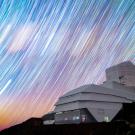
From a mountaintop in Chile, under clear dark skies, NSF–DOE Vera C. Rubin Observatory has begun the revolutionary Legacy Survey of Space and Time (LSST). The ten-year survey is Rubin’s signature campaign to create the most comprehensive, cinematic record of the Universe in history.
Rubin Observatory is a U.S. government facility jointly operated by NSF NOIRLab and DOE’s SLAC National Accelerator Laboratory. NOIRLab is managed by the Association of Universities for Research in Astronomy (AURA).
Tony Tyson, the observatory's chief scientist and its founding director, is a Distinguished Research Professor in the Departments of Physics and Astronomy at the University of California, Davis.
Over the next ten years, Rubin will relentlessly observe the entire southern sky every few nights to create an ultra-wide, ultra-high-definition time-lapse record of our Universe. This long-awaited milestone is the culmination of years of effort by thousands of people around the world. It follows the celebratory Rubin First Look event that took place in June 2025, which was followed by final commissioning work, an operational readiness review, and the beginning of the alert stream.
The observatory's unique design combines enormous light-collecting power, the ability to move rapidly across the sky, and a wide field of view. Its 3200-megapixel camera — the largest digital camera in the world — is now capturing a new, detailed image approximately every 40 seconds. Operating with this speed and sensitivity, Rubin functions as a unified, well-tuned system capable of catching faint objects and fleeting events with remarkable reliability and consistency every night.
Each night, Rubin is collecting approximately ten terabytes of data and producing as many as seven million alerts of changes in the night sky. These alerts stream to alert brokers — automated systems that sort and classify these changes so scientists can act quickly.
When the LSST is complete, the final dataset will contain billions of objects with trillions of measurements, all accessible through regular data releases. This is the first time so much astronomical data will be available to so many people, opening the door to new kinds of discovery by both scientists and the public. Rubin invites anyone in the world to engage with its data and explore the dynamic Universe in ways never before possible.
This article is adapted from a press release from the Rubin Observatory.
YOU MAY ALSO LIKE THESE STORIES

Tony Tyson Named to TIME's List of 100 Most Influential People of 2026
The TIME100 list recognizes the impact, innovation and achievement of the world’s most influential individuals.
Sifting Through the Cosmic Noise
Tony Tyson, a Distinguished Research Professor in the Department of Physics and Astronomy, recounts the origin of the Rubin Observatory and his decades-long journey to make the facility a reality.