While not nearly as prevalent or long-lived in the atmosphere as carbon dioxide, increasing methane emissions are a problem for the environment. Responsible for about one-third of the Earth’s warming, methane is about 80 times more powerful in terms of global heating than carbon dioxide. Oceanographer Tessa Hill talks about what can be done to mitigate this.
UC Davis researchers have developed a new method that uses light to transform amino acids — the building blocks of proteins — into molecules that are similar in structure to psychedelics and mimic their interaction with the brain.
The newest results from LUX-ZEPLIN (LZ) extend the experiment’s search for low-mass dark matter and set world-leading limits on one of the prime dark matter candidates: weakly interacting massive particles, or WIMPs. They also mark the first time LZ has picked up signals from neutrinos from the sun, a milestone in sensitivity.
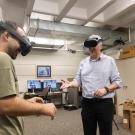
Imagine a virtual space in which an AI instructor effectively guides students through an interactive lesson plan, like building an electronic circuit. Students in remote locations or who need extra stimulation can receive instruction from a virtual agent that can meaningfully communicate with them using verbal and nonverbal methods. This is what Michael Neff is doing in his lab at UC Davis.
Tucked beside the Earth and Physical Sciences Building, the California Rock Garden is one of UC Davis’ most unique outdoor classrooms. With more than 50 boulders and core samples on display, the garden tells stories of ancient oceans, erupting volcanoes, and shifting landscapes. Take a walk with us as we explore five featured specimens that stand out both in beauty and scientific significance.
A new federally funded research project at the University of California, Davis, endeavors to extract valuable components for magnets, lasers and other modern technologies from an unlikely source: acidic wastewater from mines and industrial processes.
The outer planets of the Solar System are swarmed by ice-wrapped moons. A new study published Nov. 24 in Nature Astronomy sheds light on what could be going on beneath the surface of these worlds and provides insights into how their diverse geologic features may have formed.
In a new study appearing in the Proceedings of the National Academy of Sciences, UC Davis researchers challenge the idea that the volcanic eruptions triggered a single global, environmental collapse all at once. Rather, the devastation and environmental collapse on land happened regionally and in stages.
Earthquake faults deep in the Earth can glue themselves back together following a seismic event, according to a new study led by researchers at the University of California, Davis. The work, published Nov. 19 in Science Advances and supported by grants from the National Science Foundation, adds a new factor to our understanding of the behavior of faults that can give rise to major earthquakes.
Every year, the Bodega Marine Laboratory hosts summer sessions for undergraduate students interested in coastal systems and marine science. During the roughly five-week program, students take classes in topics like coastal oceanography, marine environmental issues and biological oceanography. They conduct fieldwork and go on field trips to nearby sites like the Hog Island Oyster Company. Students can even live at the lab’s on-site dormitory during the session.