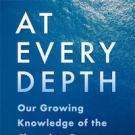
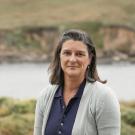
While so much of the ocean is still a mystery to us, the beauty and life within it are being affected by our choices as a species. At Every Depth: Our Growing Knowledge of the Changing Oceans by oceanographer Tessa Hill and writer Eric Simons chronicles those changes through the eyes of the community members closest to the shores. But the book is not a passive volume. Instead, it’s a call to action.
In the prologue for their book At Every Depth: Our Growing Knowledge of the Changing Oceans, UC Davis scientist Tessa Hill and writer Eric Simons open with an astute observation about humanity’s relationship with the ocean. While so much of the big blue is still a mystery to us, the beauty and life within it are being affected by our choices as a species. In some ways, the oceans are changing faster than we can study them.
Created over 10 years ago by Professor of Chemistry Jared Shaw, the Davis Science Café provides an avenue for the community to learn about the current state of science across its many disciplines. Learn more about the Davis Science Café in the above video. The meetings are held on the second Wednesday of every month at G Street WunderBar in Davis at 5:30 p.m.
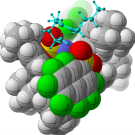
In nature, organic molecules are either left- or right-handed, but synthesizing molecules with a specific handedness in a lab is hard to do. Make a drug or enzyme with the wrong “handedness” and it just won’t work. Now chemists at the College of Letters and Science at UC Davis are getting closer to mimicking nature’s chemical efficiency through computational modeling and physical experimentation.
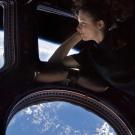
Astronaut Tracy C. Dyson graduated from the College of Letters and Science at UC Davis with a doctorate in chemistry in 1997. In March, Dyson will travel to the International Space Station (ISS) as a flight engineer and member of the Expedition 70/71 crew. The journey marks her third trip to space.
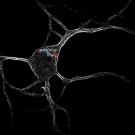
Earlier this year, a team of researchers from the UC Davis Institute for Psychedelics and Neurotherapeutics revealed in Science that psychedelics spur cortical neuron growth by activating intracellular pools of 5-HT2A receptors. This neuroplasticity combats the withering dendritic spines characteristic of several neuropsychiatric disorders.
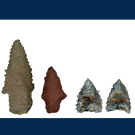
When did archery arise in the Americas? And what were the effects of this technology on society? These questions have long been debated among anthropologists and archaeologists. But a recent study published in Quaternary International and led by an anthropologist from the College of Letters and Science at UC Davis is shining light on this mystery.
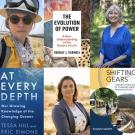
Knowledge about the Earth and its environment is woven throughout these new books, including two from College of Letters and Science faculty, that came out in 2023 or are about to be published. From oceans, fire and evolution to transportation and sustainability, these books inspire action on the world’s most pressing environmental issues.
As a UC Davis associate professor in the Department of Chemistry at the College of Letters and Science, Jesús Velázquez employs his chemistry expertise to synthesize materials useful for environmental remediation, transforming carbon dioxide-based waste streams, and energy conversion and storage. With his sights set on transforming the world for the better through chemistry, Velázquez, ever humble, never fails to thank the family members and academic mentors who guided his life path. Their imprint echoes into today, informing how he mentors and teaches.
A mathematics professor at the UC Davis College of Letters and Science recently received a prestigious honor from the Association for Women in Mathematics (AWM) and the American Mathematical Society (AMS). The organizations named Professor Anne Schilling, chair of the Department of Mathematics, as the 2024 AWM-AMS Emmy Noether Lecturer.