




The halo-shaped lights in the UC Davis Conference Center were dimmed. The room was full, the rows of seats occupied by an eager public. Projected on the screen at the front of the room was a high-resolution image of the universe captured by the Hubble Space Telescope. The image showed a blanket of galaxies in spectacular luminescence.
“What you’re seeing are tens of thousands of galaxies, some of which are a trillion times fainter than anything you can see with your naked eye,” said Nobel Laureate Adam Riess, who stood behind a podium. “And this is just a small patch of sky. If you took a single grain of sand and held it out at arm’s length, you can cover this patch. So this just gives you a perspective of how much is out there.”

Out there — beyond the walls of the conference center, beyond the UC Davis campus, beyond the atmosphere — the universe. Inside the UC Davis Conference Center, Riess guided a rapt audience through the current scientific understanding of its expansion story.
It’s a story Riess — the Bloomberg Distinguished Professor and the Thomas J. Barber Professor of Physics and Astronomy at Johns Hopkins University, and a senior staff member at the Space Telescope Science Institute — played a pivotal role in revealing.
In 2011, Riess was one of three scientists awarded the Nobel Prize in Physics “for the discovery of the accelerating expansion of the universe through observations of distant supernovae.”
In a lecture infused with cosmic curiosity, humor and stellar visuals, Riess told the 400 plus people in the audience how he and his colleagues accomplished this.
Measuring the universe: how astronomers calculate cosmic distances
To resolve questions concerning distance in space, astronomers rely on “standard candles,” which are incredibly bright objects in space with known luminosities, such as supernovae. Using the luminosity of these objects, astronomers harness a concept from mathematics called the inverse square law to discern their distances.
“Now, when we see these stars, we not only see the brightness of their light, but we also see the wavelengths — the color of the light,” said Riess, noting that as the light travels, its wavelengths stretch resulting in a phenomenon known as a redshift. “The expansion of space stretches those wavelengths of light, making them redder.”
“Astronomers like me go out, we look for these standard candles, measure their distance from their brightness,” he added. “We measure their redshift, this apparent motion away from us and actually the expansion of space.”
Riess recounted how the work of famed early 20th century astronomers Edwin Hubble and Vesto Slipher solidified this idea that the universe is expanding by comparing distance measurements with redshifts.
Riess illustrated this with a graph.
“It doesn’t look impressive, but this is really one of the most iconic graphs in all of science,” he told the audience, joking that if he ever got a tattoo, it would be of this graph. “It demonstrated for the first time that the universe is expanding.”
The findings also led to the first estimate of the rate of that expansion, what astronomers now call the Hubble Constant.
The Hubble Constant and the discovery of an expanding universe

The Hubble Constant, and the further refining of its value, ushered in a wave of discovery. Using it, astronomers narrowed down the universe’s age to roughly 13.8 billion years old.
Despite the knowns and discoveries, questions and mysteries abounded. Experimentalists and theorists calculated different values of the Hubble Constant, leading to further questions.
Was the universe’s expansion accelerating or decelerating? Would the expansion ever stop? And was there some unseen force or matter influencing it?
Starting in the 1990s, Riess, who was a doctoral student at Harvard University, began using a specific type of supernovae, called Type 1a, to investigate these questions.
A Type 1a supernova occurs in binary star systems when one of the stars becomes a white dwarf. Astrophysicist Subrahmanyan Chandrasekhar discovered that these white dwarfs can only have a maximum mass about 1.44 times the sun’s mass before collapsing and causing a Type 1a supernovae.
“Those stars sometimes get too close and the material is transferred over until it crosses this Chandrasekhar limit and explodes,” Riess said. “This makes an incredibly uniform explosion, which is what makes it a great standard candle.”
The problem was Type 1a supernovae were rare, occurring about once every century in a galaxy like the Milky Way.
“Finding a supernova is like winning the lottery, but you can win the lottery if you buy all the lottery tickets,” Riess said. “In our case, what astronomers learned to do was they learned to take very wide images with new technology cameras, particularly one built by Tony Tyson of the department here.”
“Here,” of course, meaning UC Davis.

A breakthrough that redefined cosmology
By 1997, Riess and his colleagues had collected data on 16 Type 1a supernovae. The team compared these distant supernovae with data from a host of other nearby supernovae. By doing that, they could determine the changes in the universe’s expansion rate over time.
“The objects that we look at are so far away that we really are collecting information not about the present but about the past,” Riess said. “There’s a built-in delay. I like to say that the universe doesn’t instant message.”
When Riess crunched the numbers using the data from the astronomical observations, the answer didn’t make sense. He kept getting a negative mass for the universe.
“It’s supposed to be either something small, like between zero and one, and the universe would expand forever,” Riess said, “or more than one, and it would re-collapse, but negative was not part of the bargain.”
At the time, Einstein’s cosmological constant — used to describe an unseen, repulsive force in a static universe — had fallen out of favor with the astronomy community. Hubble’s discovery that the universe was expanding seemingly contradicted Einstein’s cosmological constant.
But Riess realized that Einstein’s cosmological constant was still significant. When he inputted it into the equations, it fit well, leading him to conclude that Einstein’s cosmological constant was still a necessary part of the universe’s expansion story.
Riess and his colleagues published their findings in the landmark paper “Observational Evidence from Supernovae for an Accelerating Universe and a Cosmological Constant” published in the Astronomical Journal.
“By comparing distant and nearby supernovae, it implied that the expansion was now accelerating and that 70% of the universe is in the form of dark energy that Einstein had hypothesized,” Riess said.
The finding was named by Science magazine as the “Breakthrough Discovery of the Year” in 1998 and eventually led to Riess’ receipt of the Nobel Prize.
Unsolved mysteries of the cosmos: what comes next
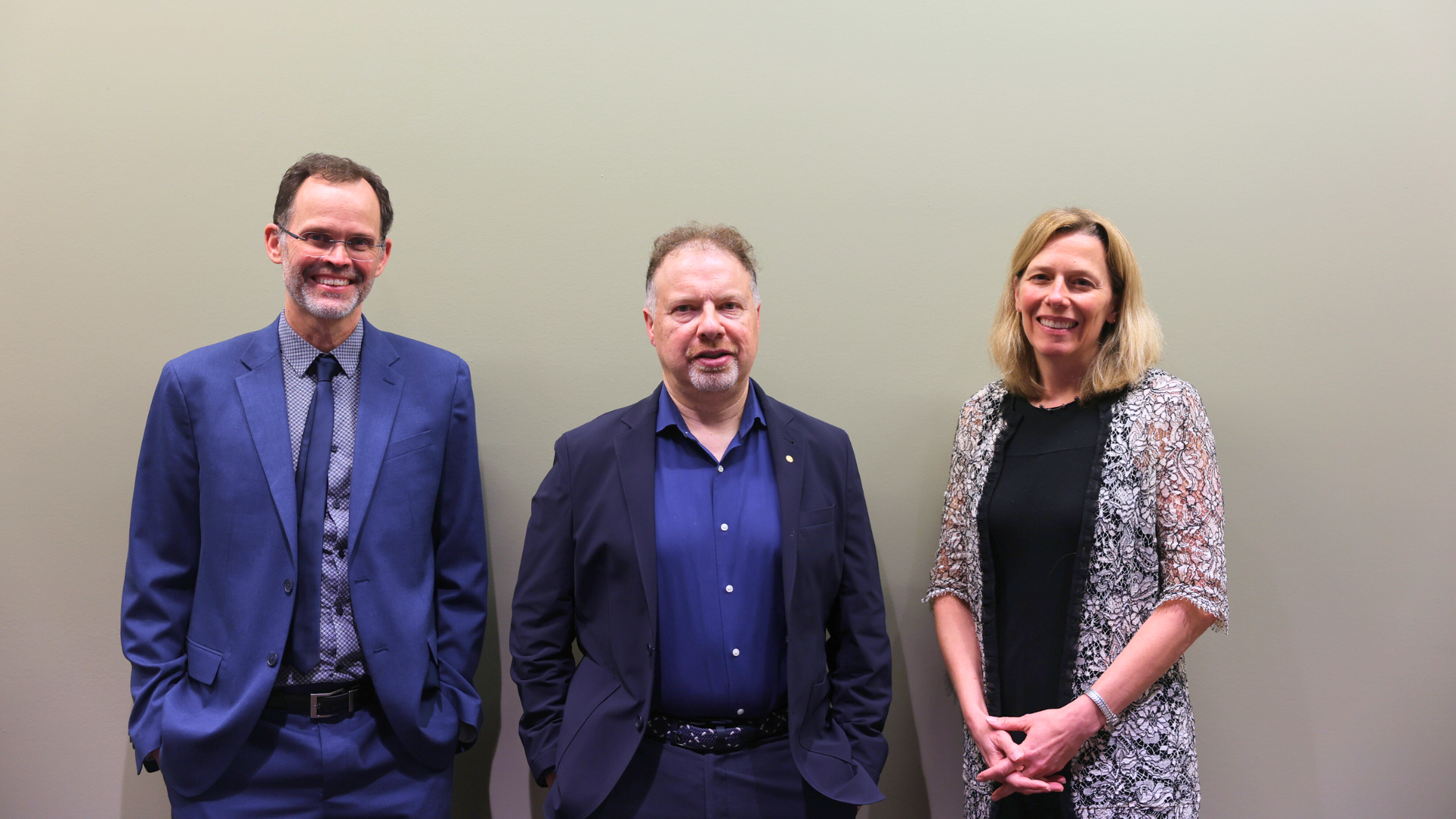
As the lecture wound down, Riess reminded the audience that the universe’s expansion story is far from being complete. There are unknown actors like dark energy and longstanding mysteries, like why the Hubble tension exists or why quantum physics and general relativity don’t align.
As new astronomical facilities, like the Vera C. Rubin Observatory, are built and launched, scientists get closer to answering these questions.
“We discovered a lot of things,” Riess said. “We’re stuck on a few problems, but we have more data coming in, so I think it’s an exciting time to be studying this area.”
YOU MAY ALSO LIKE THESE STORIES
What are Gravitational Lenses?
In the past, identifying gravitational lenses in the night sky was an incredibly cumbersome task. It required sharp eyes, time and the drive to sift through tens of thousands of images gathered by telescopes. But within the last five years, researchers like Tucker Jones, through collaboration with computer scientists, have started employing machine learning algorithms to identify gravitational lens candidates in the sky.
Sifting Through the Cosmic Noise
Tony Tyson, a Distinguished Research Professor in the Department of Physics and Astronomy, recounts the origin of the Rubin Observatory and his decades-long journey to make the facility a reality.