




The results of two decades of scientific and technological innovation were unveiled today with the reveal of the first imagery captured by the Vera C. Rubin Observatory, a facility jointly funded by the National Science Foundation and the U.S. Department of Energy's Office of Science.
Located atop Cerro Pachón in Chile, the Rubin Observatory is equipped with the largest digital camera ever built and will allow scientists to probe a wide-range of questions about our universe, from its origin and structure to the nature of dark energy and dark matter, as well as mysteries about our solar system, among others.
"In just over 10 hours of test observations, NSF–DOE Rubin Observatory has already captured millions of galaxies and Milky Way stars and thousands of asteroids," the observatory's team said in a statement. "The imagery is a small preview of Rubin Observatory's upcoming 10-year scientific mission to explore and understand some of the universe's biggest mysteries."
The first image revealed by the team showcased a dizzying and expansive display of stars, elliptical galaxies, galaxy clusters and other celestial objects. And yet, that image was just a small portion (about 2%) of an even larger image captured by the the observatory's 3200-mexapixel LSST Camera.
The reveal was just a preview of what's to come. Over the next 10 years, the Rubin Observatory will create an image 1000 times larger than what was observed during its test observations. That survey will start later this year.
The team also revealed a movie showing the first thousands of asteroids discovered by the Rubin Observatory. An additional composite image revealed the clouds of gas and dust that comprise the Trifid Nebula and the Lagoon Nebula.
The Rubin Observatory's origins have ties to UC Davis. Tony Tyson, the observatory's chief scientist, is a Distinguished Research Professor in the Department of Physics and Astronomy.
For nearly three decades, Tyson has helped shepherd the ideation of and technology behind the Rubin Observatory. In his simulation lab at UC Davis, he and colleagues refined and tweaked the underlying imaging technology employed by the observatory, with the intent to ready its cameras for the noise and interference it will encounter during observations.
You can learn about Tyson's involvement with the Rubin Observatory in our feature article "Sifting Through the Cosmic Noise: Origins of the Rubin Observatory with Chief Scientist Tony Tyson."

YOU MAY ALSO LIKE THESE STORIES
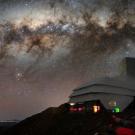
Origins of the Rubin Observatory with Chief Scientist Tony Tyson
Tony Tyson, a Distinguished Research Professor in the Department of Physics and Astronomy, recounts the origin of the Rubin Observatory and his decades-long journey to make the facility a reality.

A Galaxy of Memories with Lori Lubin
Light pollution dampens our view of the stars, hindering our connection to the universe above. It’s one of the reasons why astronomical observatories are erected in remote, often pristine, places. The opportunity to travel to such places drew Lori Lubin to astronomy.