




Welcome to Books of the Month, where once a month, we select works from our Bookshelf of authors within the College of Letters and Science at UC Davis. January is often a time for self-reflection and goal setting, so this month’s list features books that touch on both.
The world feels like it is changing fast, but it doesn’t mean we can’t take time to build our awareness and move forward mindfully. We get to decide where we want to put our time, energy, attention and resources. We hope some of these titles can help guide you with your big plans this year.

Why We Remember: Unlocking Memory's Power to Hold on to What Matters
Charan Ranganath (Department of Psychology)
In Why We Remember: Unlocking Memory's Power to Hold on to What Matters, Professor Charan Ranganath radically reframes the way we think about memory. Combining accessible language with cutting-edge research, he reveals the surprising ways our brains record the past and how we use that information to understand who we are in the present, and to imagine and plan for the future.

The Genius Checklist: Nine Paradoxical Tips on How You Can Become a Creative Genius
Dean Keith Simonton (Department of Psychology)
Dean Keith Simonton, distinguished professor emeritus of psychology, examines the key factors in creative genius and finds that they are more than a little contradictory. Simonton, who has studied creativity and genius for more than four decades, draws on both scientific research and stories from the lives of famous creative geniuses.

The Habitation Society: Creating Sustainable Prosperity
Fred Block (Department of Sociology)
In The Habitation Society, leading economic and political sociologist Fred Block argues that we are at a time of “blocked transition” from one mode of economic and social organization to another. And, in the absence of concepts to make sense of what is happening, the political space becomes filled with conspiracy theories and disinformation. It’s become extremely difficult for people to understand their own relationship to the larger economy and society. Block’s compelling analysis offers clarity to this confusion and a means to understand our transitions. He examines the contemporary economy and maps out more effective pathways in the hope that this will empower individuals to recognize the kinds of changes that could be made to improve things for themselves, their families and their communities.

Real Food, Real Facts
Charlotte Biltekoff (Department of American Studies)
Real Food, Real Facts by Charlotte Biltekoff is about how good food became “real” in the beginning of the 21st century and how the food industry has responded to increasingly negative public views of processed food with science-based education and information campaigns designed to “correct” what they see as public misperceptions.

Everyone Breaks These Laws
Gerardo Con Díaz (Department of Science and Technology Studies)
Gerardo Con Díaz examines the strange world of online copyrights from the 1990s to today’s AI-driven era, showing how our ability to immerse ourselves in digital media depends on the erosion of what it means for people to own their creative works, online and offline.

Fighting Words!
Eric Louise Russell (Department of French and Italian)
Fighting Words! A Critical Approach to Linguistic Transgression looks at some of these linguistic dumpster fires – what Eric Louise Russell calls “acts of linguistic transgression,” or the ways people cross boundaries through language. He explains the necessity of learning about linguistic transgression by likening it to disease.

Shamanism: The Timeless Religion
Manvir Singh (Department of Anthropology)
What are the origins of shamanism, and what is its future? Following a fascinating cast of characters, Anthropology Professor Manvir Singh reveals the complexities and vicissitudes of a timeless, always relevant, and ubiquitous phenomenon. He argues that biomedicine can learn from shamanic practices and that psychedelic enthusiasts completely misrepresent history. He also shows that shamanic traditions will forever re-emerge – and that by contemplating humanity’s oldest spiritual practice, we come to better understand ourselves, our history, and our future.
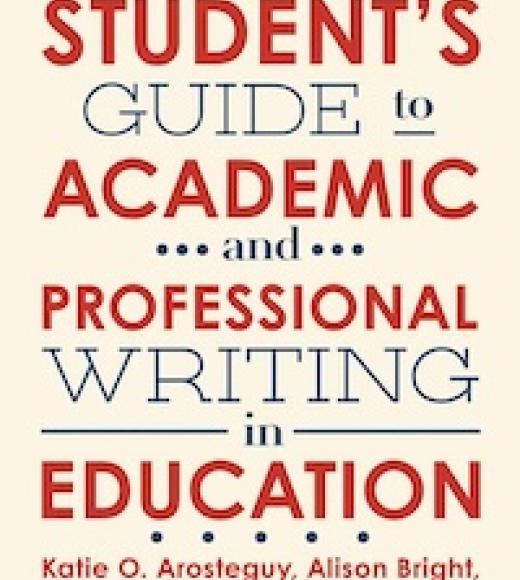
A Student's Guide to Academic and Professional Writing in Education
Katie Arosteguy, Alison Bright and Brenda Rinard (University Writing Program)
This concise handbook written by University Writing Program faculty Katie Arosteguy, Alison Bright and Brenda Rinard, prepares educators to write for the rhetorical situations they will face as students of education, and as preservice and practicing teachers. It provides clear and helpful advice for responding to the varying contexts, audiences, and purposes that arise in four written categories in education: classroom, research, credential and stakeholder writing.

Media U: How the Need to Win Audiences Has Shaped Higher Education
John Marx (Department of English)
Media U, co-written by English Professor John Marx, presents a provocative rethinking of the development of American higher education centered on the insight that universities are media institutions. Tracing over a century of media history and the academy, they argue that the fundamental goal of the American research university has been to cultivate audiences and convince them of its value.
YOU MAY ALSO LIKE THESE STORIES

How We Imagine Who We Will Be in a New Place
Cognitive migration describes when our imagination guides us through potential futures. It’s a process through which we work out the emotional, cognitive and social problems of traveling to a new location by putting ourselves in a future time and space.

Feeling Guilty? There's a Cure for That
Philosopher Hannah Tierney studies the idea of blameworthiness and what it means to successfully make amends. Her research focuses on the reparative process that unfolds after someone causes harm. It also offers insight into how to ease burdens of national guilt that might affect people across a society.