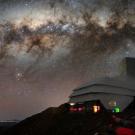
The Vera C. Rubin Observatory recently launched its 10-year astronomical survey to create the most comprehensive, cinematic record of the universe. While thousands of people played a part in making the facility a reality, Tony Tyson played a formative role, acting initially as the facility’s founding director and now its chief scientist. We sat down with Tyson to discuss his background and the technology behind the Rubin Observatory’s revolutionary camera.
Five researchers from the University of California, Davis, including two from the College of Letters and Science, were listed among recipients for the inaugural awards through the U.S. Department of Energy’s, or DOE, Genesis Mission — a national program leveraging artificial intelligence to accelerate breakthroughs in energy, discovery science and national security.
From a mountaintop in Chile, under clear dark skies, NSF–DOE Vera C. Rubin Observatory has begun the revolutionary Legacy Survey of Space and Time (LSST). The ten-year survey is Rubin’s signature campaign to create the most comprehensive, cinematic record of the Universe in history.
Chemistry graduate student Cocoro Nagasaka works at the interface of environmental and energy sciences. And now he’s continuing his research at the Lawrence Livermore National Laboratory, or LLNL, through the prestigious U.S. Department of Energy’s Office of Science Graduate Student Research program.
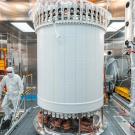
The newest results from LUX-ZEPLIN (LZ) extend the experiment’s search for low-mass dark matter and set world-leading limits on one of the prime dark matter candidates: weakly interacting massive particles, or WIMPs. They also mark the first time LZ has picked up signals from neutrinos from the sun, a milestone in sensitivity.
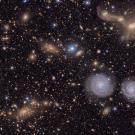
The results of two decades of scientific and technological innovation were unveiled today with the reveal of the first imagery captured by the Vera C. Rubin Observatory, a facility jointly funded by the National Science Foundation and the U.S. Department of Energy's Office of Science.
University of California researchers, in collaboration with University of Michigan researchers, have developed a method to take carbon dioxide, an industrial waste product that pollutes the atmosphere, and turn it into something useful: precursors to make cement.
Tatiana Mamani, a Ph.D. candidate in physical chemistry working with Professor of Chemistry Davide Donadio, is among 62 Ph.D. students selected nationwide to participate in Department of Energy's Office of Science Graduate Student Research program.
New results from the world’s most sensitive dark matter detector, LUX-ZEPLIN (LZ), have narrowed down possibilities for one of the leading dark matter candidates: weakly interacting massive particles, or WIMPs.
Coming online in 2025, the NSF-DOE Vera C. Rubin Observatory's enormous, unrelenting eye on the sky will create the biggest, most data-rich movie ever made — a 10-year, high-precision chronicle of trillions of cosmic events and objects across space and time.