A scholar examining the portrayal of the pregnant and postpartum body in maternal narratives of the Hispanic world, a historian examining the Middle Eastern diaspora in the Golden State and a chemist investigating the role of metal micronutrients in human health have been named 2024 Dean’s Faculty Fellows.
Thirteen faculty members from the College of Letters and Science at UC Davis were recently awarded Revitalization Research Program Grants. Intended to support faculty whose research programs have been impacted by the COVID-19 pandemic, the college-funded grants support the continuation or completion of stalled, high-priority projects. The selected faculty members represent the breadth of research conducted at the College of Letters and Science.
Kathy Stuart, associate professor of history, delights in crime and deviance — her research specialty. Her research has inspired a period film, "The Devil’s Bath," based on her latest research and book, "Suicide by Proxy in Early Modern Germany: Crime, Sin and Salvation."
A science historian studying the complex history of sociogenomics, a historian revealing the lives of Chilean children during Augusto Pinochet’s dictatorship, and a researcher chronicling the performances of contemporary Black women poets are among this year’s UC Davis recipients of grants from the National Endowment for the Humanities (NEH).
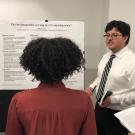
Students from across the College of Letters and Science at UC Davis shared their research on some of California’s most pressing policy issues in a fast-paced poster session during this summer’s UC Center Sacramento Undergraduate Research Showcase.
Garden of the World: Asian Immigrants and the Making of Agriculture in California’s Santa Clara Valley (Oxford University Press, 2013) explores the ways in which Chinese, Japanese, and Filipino immigrants transformed agricultural practices along with ideologies of race and American national identity from 1880 to 1940 in a region once celebrated around the world for its horticultural productivity, now commonly known as “Silicon Valley.”
Historian Ellen Hartigan-O'Connor traces the lives of urban women in early America to reveal how they used the ties of residence, work, credit, and money to shape consumer culture at a time when the politics of the marketplace was gaining national significance.