This month, explore how connections are formed, maintained and shared with letters and science authors. In this collection of books, our authors and scholars mine their own families as their inspiration for memoirs, poetry, fiction and analyses.
Why are so many of us afraid of snakes? And more curiously, why does our unconscious mind recognize them as a threat before our conscious mind? Distinguished Professor Emerita of Anthropology Lynne A. Isbell dives into how our relationship with snakes is an ancient one that reaches back to the evolutionary origins of primates.
How do pilgrimages get established? How do people become convinced to try something new? Using a theoretical game model, University of California, Davis, anthropologists suggest that lucky outcomes can sometimes give rise to the perception that a new site cures, blesses, grants miracles or otherwise produces great outcomes in pilgrims’ lives.
From early Japanese folklore and Dante’s Inferno to post-Soviet film and modern-day scapegoating in the U.S., humanity has long grappled with its fears through storytelling as well as violence. This collection of books traverses these themes, diving deep and analyzing the way these anxieties manifest in our behavior, political decisions and the creative works we produce.
A genomic analysis of over 1,200 people from across South Africa reveals how colonial-era European, Indigenous Khoe-San peoples, and enslaved people contributed to the modern-day gene pool in South Africa.
Explore new interpretations of classic land ethics, multiple cases of climate action and land sovereignty and witness how past generations reacted to the changing climate. Scholars from across the College of Letters and Science provide insight into how human action and inaction has influenced the natural environment around us.
In a study recently published in Geochimica et Cosmochimica Acta, an international research team analyzed teeth from 14 different primates, including one human, to better understand the rainfall or water input patterns across their lifetimes.
Two chemists studying debilitating diseases and a population geneticist untangling early human evolution are the recipients of this year’s Incentives for Large Grant Awards from the College of Letters and Science at UC Davis. The Incentives for Large Grant Awards program provides faculty with up to $80,000 in support over two years to pursue large grants over $1 million.
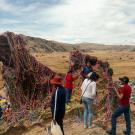
Archaeologists have long thought that monumental architecture were products of societies with power structures, including social hierarchy, inequality and controlled labor forces. In new research, researchers report evidence of monumental structures built by hunter-gatherer groups at Kaillachuro, a collection of burial mounds located in the Titicaca Basin of the Peruvian Andes.
A bioarcheologist interested in the diets of people long past, UC Davis Ph.D. candidate Diana Malarchik, Department of Anthropology, analyzes the geochemical signatures of teeth to better understand major shifts in breastfeeding and maternal behavior in the past. Her research is highlighting inequities between individuals of high and low socioeconomic status.