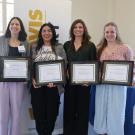
Four students were honored with awards, including three art purchase prizes. In all, 20 Master of Fine Arts, Master of Arts and doctoral students from the College of Letters and Science at UC Davis participated in the event. The design and art studio work will be exhibited at the museum through June 20.
This year’s annual Global Tea Institute Colloquium honors the legacy of tea with its theme: Art of Tea in Culture and Science, Society and Health. It will feature tea scholars from across UC Davis.
In this video, UC Davis marine scientist Elisabeth Sellinger explores the global importance of eelgrass, its role along the California coast, and how the Greater Farallones and Monterey Bay National Marine Sanctuaries help protect and restore these essential habitats.
College of Letters and Science graduate students Mikhaila Redovian and Kirsten Schuhmacher were recently announced recipients of the 2025 UC Davis Library Graduate Student Prize. The Ph.D. candidates in the Department of English, used library resources to help research, curate and design "Worlds Encompassed: Premodern Making and Mingling."
To democratize the precision medicine space, the Henn Lab is spearheading two projects funded by the National Institutes of Health for nearly $812,000.
In a new study, UC Davis researchers and their colleagues in the South Pole Telescope (SPT) collaboration used observational data of this first light — collected from the SPT located at the National Science Foundation’s Amundsen-Scott South Pole Station in Antarctica — to explore the theoretical underpinnings of the Lambda-cold dark matter model, the standard cosmological model of the Big Bang.
Join Elisabeth Sellinger and Mazie Lewis for a day of seagrass meadow monitoring research in Elkhorn Slough. A nursery habitat for many marine animals, including mammals, shellfish and fish, seagrass meadows are vital ecosystems. But their benefits don’t just touch the ocean-dwellers of our planet.
Our bodies are pharmaceutical factories, but did you know that our bodies also naturally produce psychedelics? Why do we make them? How do they work? What are their functions? And can we leverage them to mitigate neurodegenerative and neuropsychiatric conditions? The UC Davis Institute for Psychedelics and Neurotherapeutics is exploring those questions.
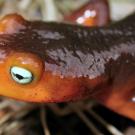
Is it possible to find a common set of genes for regeneration, that could unlock a new understanding of this process? A comparison of the expression of thousands of genes from six animals found little evidence of a core conserved trait, but does point to some new areas to investigate.