


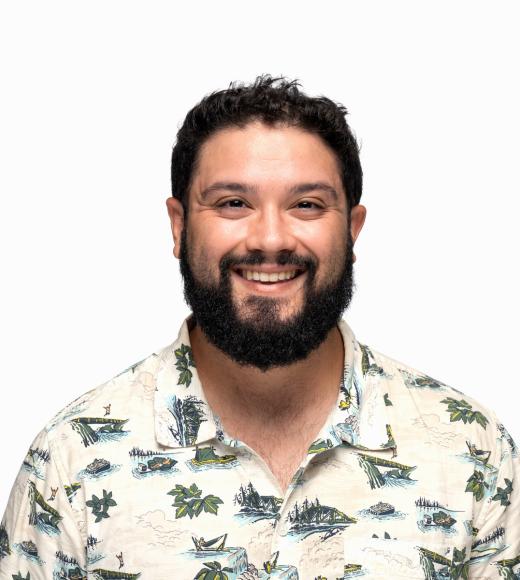
Greg Watry
Bio

Greg Watry  

Editorial Director; Department Editor, Science & Technology

Greg Watry writes about people, research and initiatives in the mathematical and physical sciences, and is a member of the college’s communications and marketing team, serving as the team's editorial director. In addition to writing and editing, Watry serves as the lead on the college's monthly research and magazine newsletters, and the quarterly alumni newsletter. He also enjoys taking photos and working on video projects.  

Watry's career includes experience in journalism, higher education and the private sector. His work has earned awards from the New Jersey Press Association, the Association for Communication Excellence and the Council for the Advancement and Support of Education. He holds bachelor's degrees in English literature and communication (media production specialization) from Villanova University and a master's degree in science, environment and medicine writing from Columbia University.  

Molecular Simulations Show Graphite ‘Hijacks’ Diamond Formation Through Unexpected Crystallization Pathways

In a new study published July 9 in Nature Communications, researchers from the University of California, Davis, and George Washington University use computer simulations to study how molten carbon crystallizes into either graphite or diamond at temperatures and pressures similar to Earth’s interior. The team’s findings challenge conventional understanding of diamond formation and reveal why experimental results studying carbon's phase behavior have been so inconsistent.

Study Suggests Remembrances of Dead Played Role in Rise of Architecture in Andean Region

Archaeologists have long thought that monumental architecture were products of societies with power structures, including social hierarchy, inequality and controlled labor forces. In new research, researchers report evidence of monumental structures built by hunter-gatherer groups at Kaillachuro, a collection of burial mounds located in the Titicaca Basin of the Peruvian Andes.

First Images Revealed From Vera C. Rubin Observatory

The results of two decades of scientific and technological innovation were unveiled today with the reveal of the first imagery captured by the Vera C. Rubin Observatory, a facility jointly funded by the National Science Foundation and the U.S. Department of Energy's Office of Science.

An Alum for the Alums: Kirk DeClark Discusses Efforts to Help Young Aggies Find Their Professional Selves

As a member of the College of Letters and Science Dean’s Advisory Council, Kirk DeClark is part of a group of civic, business and education leaders drawn from the college’s alumni, donors, emeriti and friends. For DeClark, the role has given him an opportunity to help students and young alumni explore their intellectual curiosity and career prospects.

What Do Your Teeth Reveal About Your Diet?

A bioarcheologist interested in the diets of people long past, UC Davis Ph.D. candidate Diana Malarchik, Department of Anthropology, analyzes the geochemical signatures of teeth to better understand major shifts in breastfeeding and maternal behavior in the past. Her research is highlighting inequities between individuals of high and low socioeconomic status.

The Mathematics of Daily Life

View the world through UC Davis mathematician Roger Casals Gutiérrez’s eyes and you’ll realize that mathematics is everywhere. In this article, Casals Gutiérrez shows how we encounter objects of his research interests, like singularities, in daily life.